
The AI workflow market split into two camps over the past year. One group kept stacking integrations and polishing drag-and-drop builders for non-technical users. The other went deep on developer-first APIs, exposing every node, trigger, and model call as a programmable endpoint.
If you are building a product that needs AI pipelines triggered from code, or managing a team where designers build visually and engineers deploy via CI/CD, the platform's API surface is what matters. This guide compares six platforms that ship real REST or GraphQL APIs alongside their visual builders, not just webhook-out connectors bolted on as an afterthought.
We tested each platform's API documentation, SDK quality, authentication model, and rate-limit policies against a real use case: an image generation pipeline that chains a prompt rewriter, two models, a quality gate, and an output router.
Why API Access Matters for AI Workflows
Most visual workflow tools treat API access as a secondary feature. You build in the UI, then "export" or trigger via a single webhook. That works for simple Zap-style automations, but falls apart when you need version control, programmatic creation of workflows, or multi-tenant deployment where each customer gets a slightly different pipeline.
A proper workflow API gives you the ability to create, modify, and execute workflows entirely from code. You can store workflow definitions in Git, spin up per-customer variations with a template call, and integrate execution into your existing backend without context-switching into a separate UI.
The platforms below all offer this to varying degrees, but the depth of their API surface differs dramatically.
n8n: Open-Source With Full API Control
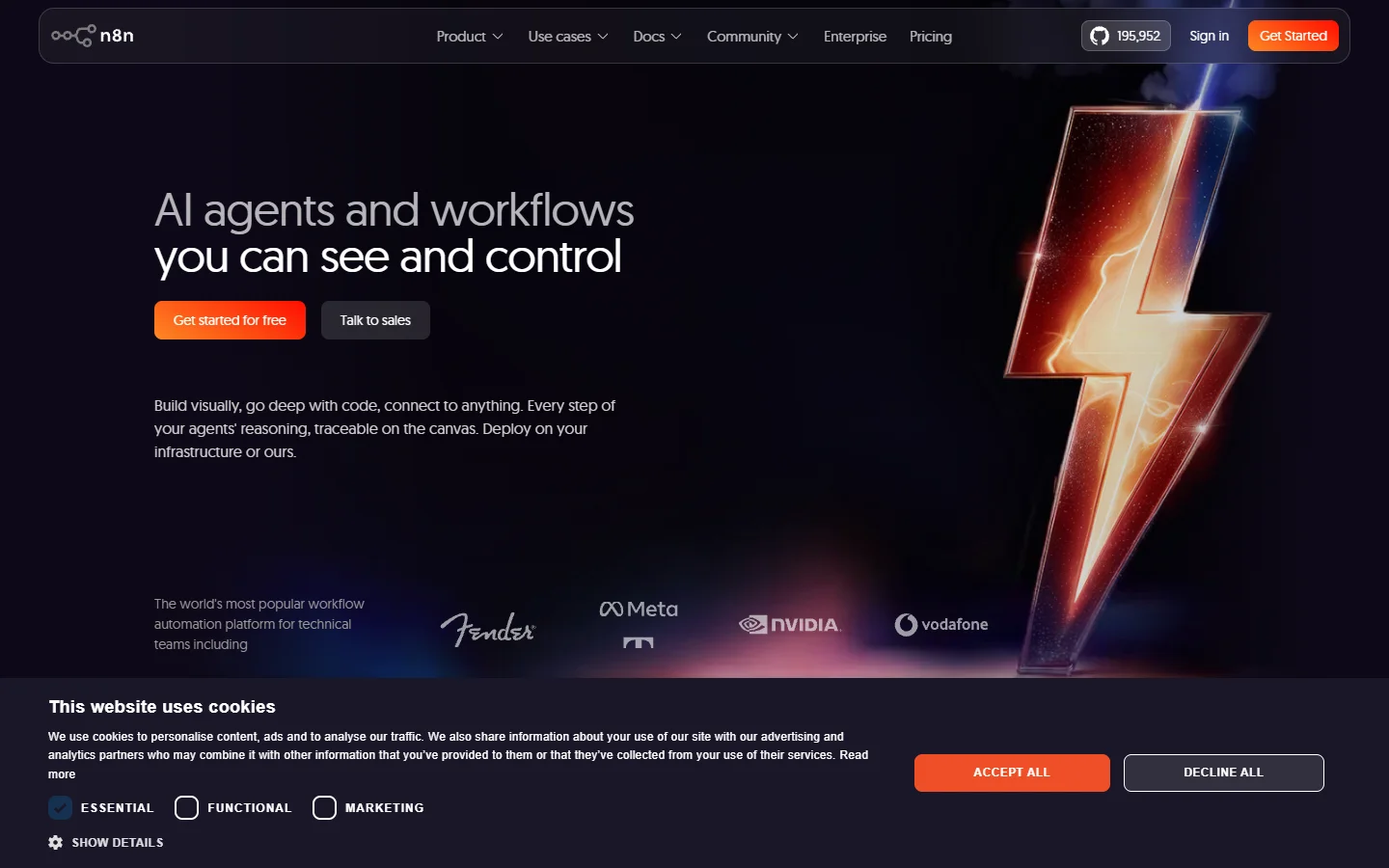
n8n is the most developer-friendly option for teams that want complete control. Its fair-code license means you can self-host on your own infrastructure, inspect every line of source, and extend it with custom nodes written in TypeScript.
The API covers workflow CRUD, execution triggers, credential management, and webhook registration. Because you own the instance, rate limits are whatever your infrastructure supports. The community maintains 400+ integration nodes, and the AI nodes (LangChain-compatible) let you wire LLMs, vector stores, and tool-use agents directly into flows.
- API depth: Full REST API for workflow management, execution, and credentials
- Self-hosting: Docker, Kubernetes, or bare metal
- AI primitives: LangChain nodes, vector store connectors, agent loops
- Pricing: Free (self-hosted), cloud plans from $20/mo
- Best for: Teams that want source access and no vendor lock-in
The tradeoff is operational overhead. You manage uptime, scaling, and upgrades yourself unless you pay for n8n Cloud.
Pipedream: API-First for Developers
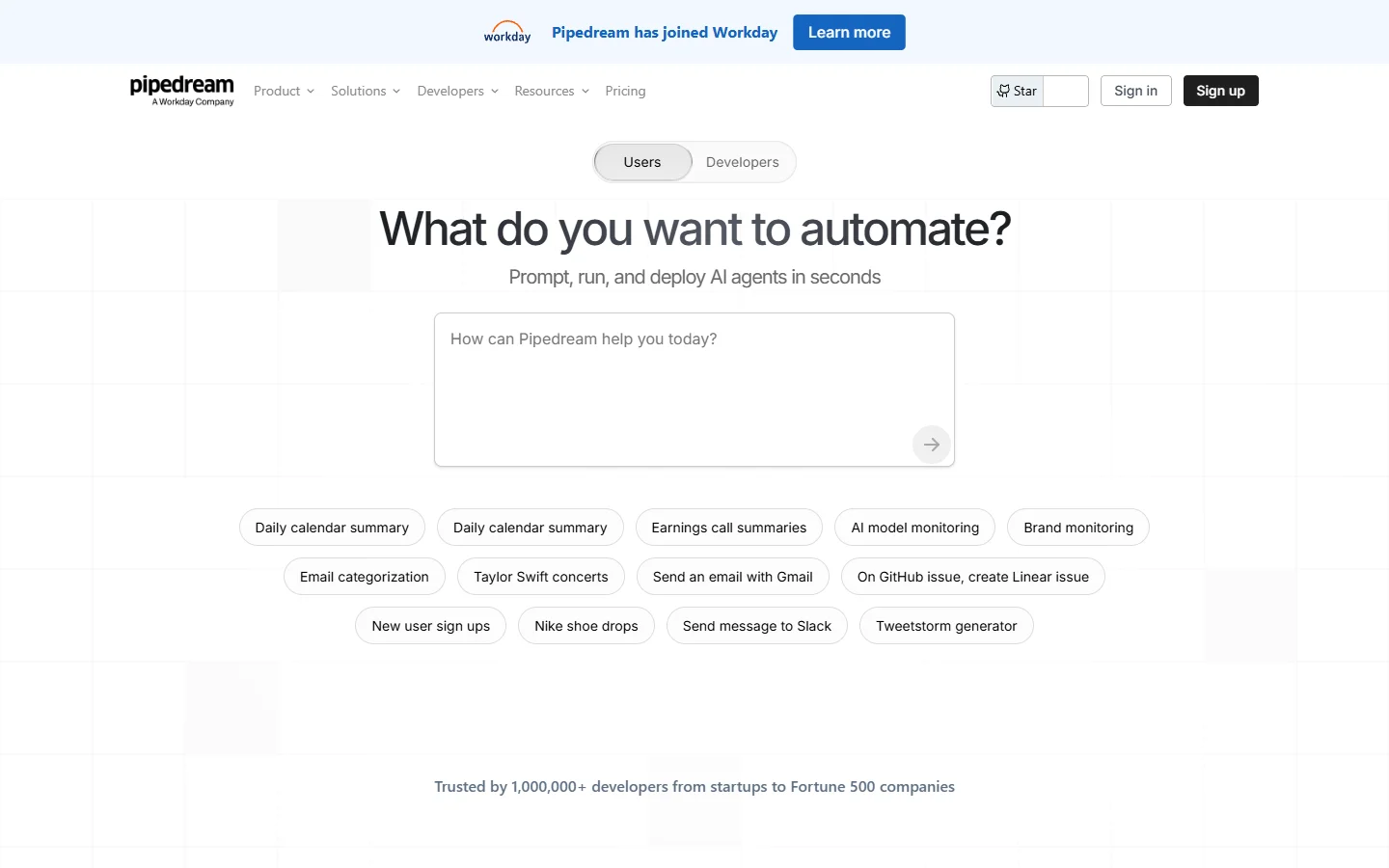
Pipedream was built for developers from day one. Every workflow is backed by a Node.js or Python runtime that you can write inline or import from npm/pip. The REST API lets you create, update, deploy, and trigger workflows programmatically.
What sets Pipedream apart is its execution model: you write steps as code files, version them in Git via their CLI, and deploy with pd deploy. The visual builder is optional, a way to prototype before writing the real implementation in code.
- API depth: Full CRUD + deployment via CLI and REST
- Runtime: Node.js 20, Python 3.11, Go (steps as code)
- AI primitives: Direct SDK calls to any model provider (no built-in AI nodes, but full code access means no limits)
- Pricing: Free tier (30k invocations), paid from $19/mo (credit-based compute)
- Best for: Developers who want code-first with visual debugging
The lack of dedicated AI nodes means you wire model calls manually via SDK imports, which gives maximum flexibility but requires more boilerplate than purpose-built AI platforms.
Zapier: Largest Ecosystem, Growing API
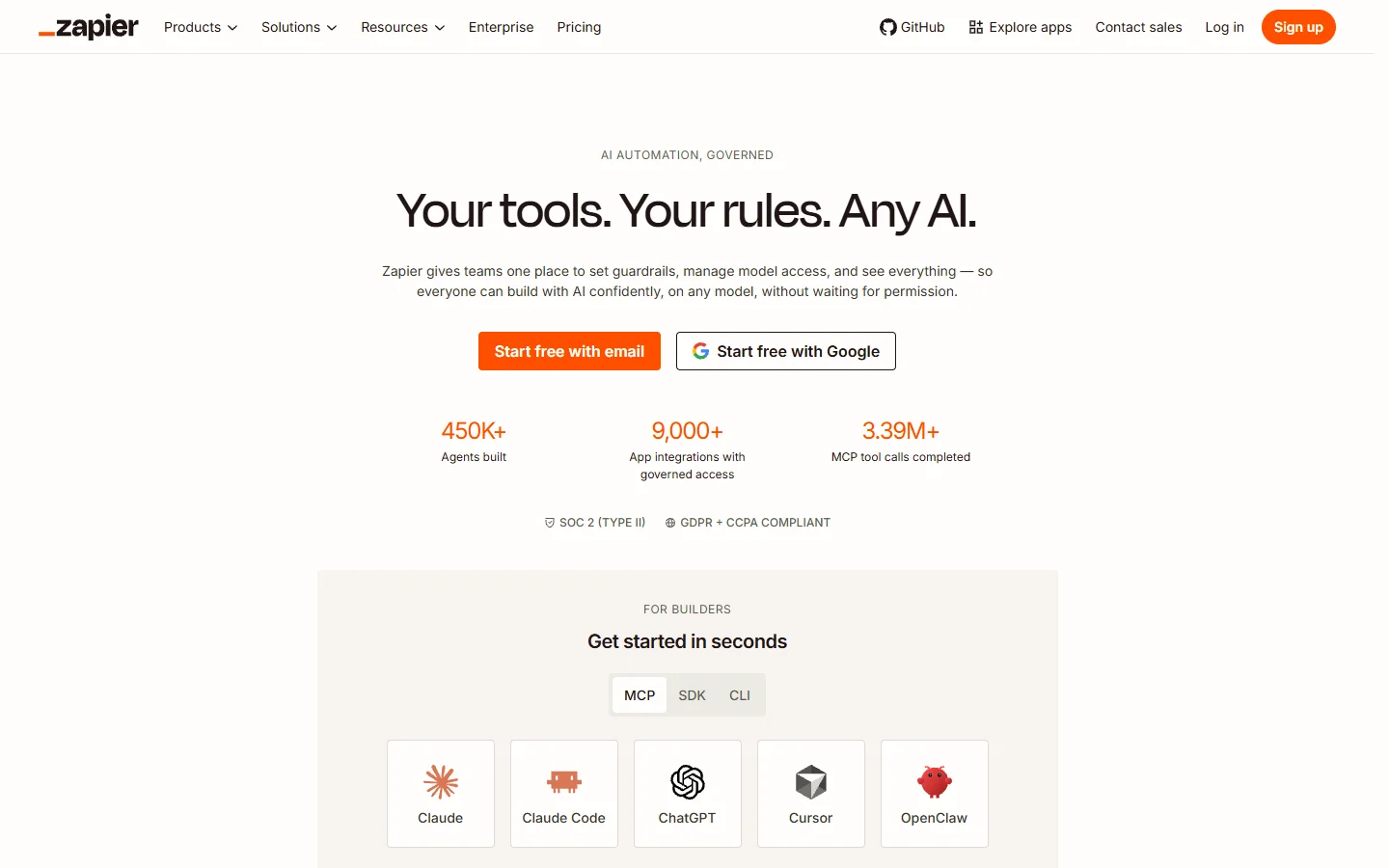
Zapier needs no introduction for its 7,000+ app integrations. The 2026 story is their expanding developer surface: the new Canvas workspace, Interfaces (front-end forms that trigger Zaps), and a REST API for programmatic Zap management.
The API lets you list, enable, disable, and trigger Zaps. Creating Zaps via API is still in beta and limited to pre-built templates, which restricts fully programmatic workflow creation. For teams that need headless deployment, this is the gap.
- API depth: Trigger and manage existing Zaps; creation limited to templates
- Runtime: Proprietary (no raw code steps in free tier; Code by Zapier on paid)
- AI primitives: ChatGPT integration, AI-powered "Copilot" for building Zaps
- Pricing: Free (5 Zaps), paid from $29.99/mo
- Best for: Teams that need the broadest integration library and don't require full API-driven workflow creation
Zapier's strength is breadth, not depth. If your use case is "connect these 12 SaaS tools and add an AI step in the middle," it is unmatched. If you need to create and version workflows from code, look elsewhere.
Activepieces: Open-Source Alternative With Clean API
Activepieces positions itself as the open-source Zapier. It ships a visual builder with 200+ connectors and a REST API that covers workflow lifecycle, from creation through execution history.
The TypeScript SDK lets you build custom pieces (their term for nodes) that integrate into the visual builder and are callable via API. Self-hosting is straightforward (Docker Compose), and the cloud option handles scaling.
- API depth: Full CRUD for flows, connections, and runs
- Self-hosting: Docker Compose, Kubernetes
- AI primitives: OpenAI, Anthropic, and Google pieces; custom piece SDK for any provider
- Pricing: Free (self-hosted), cloud from $0 (generous free tier)
- Best for: Teams that want open-source simplicity with a polished UI
The community is smaller than n8n's, which means fewer pre-built pieces for niche integrations. But the architecture is clean and the API documentation is thorough.
Langflow: AI-Native Visual Builder
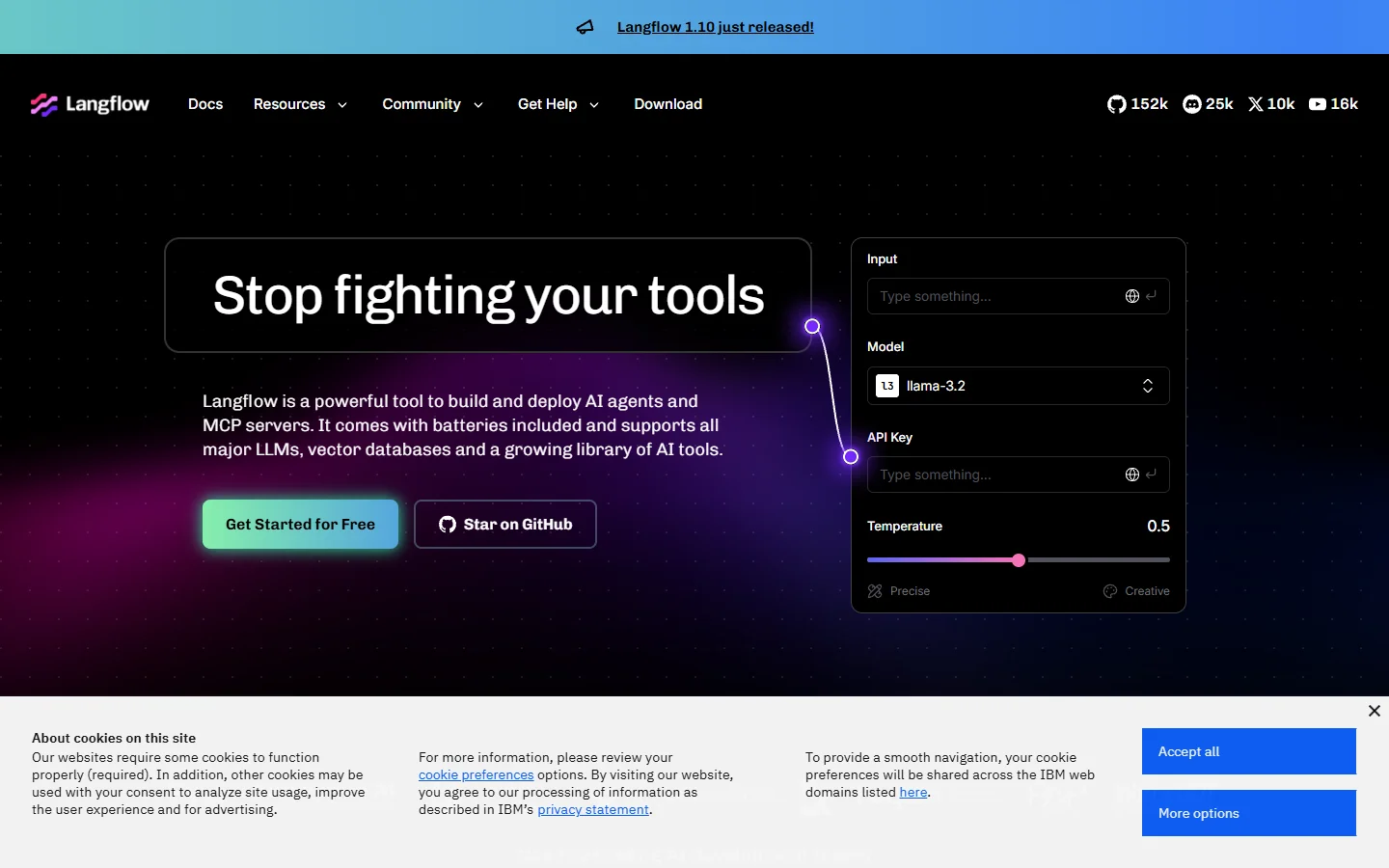
Langflow takes a different approach. Rather than being a general-purpose automation tool that added AI, it is an AI-first platform built specifically for LLM pipelines. The visual canvas is designed around AI primitives: prompts, models, retrievers, vector stores, agents, and tools.
Every flow you build gets an auto-generated API endpoint. You hit it with your input payload and get structured output back, making it function as an AI microservice builder rather than a traditional workflow tool.
- API depth: Auto-generated per-flow endpoints; global management API
- Runtime: Python (LangChain-native)
- AI primitives: First-class RAG, agents, tool-use, memory, multi-model routing
- Pricing: Free (open-source), DataStax-hosted cloud available
- Best for: Teams building complex AI agents and RAG pipelines that need visual debugging
The limitation is scope. Langflow does not handle general SaaS integrations (no "when a Stripe payment comes in, trigger a pipeline"). It is purely for AI/ML orchestration.
Specialized AI Platforms: Visual Canvas With Headless API
For teams that need both a visual builder and production-grade API access, there is a middle path. Platforms that started as visual canvases for creative AI (image generation, video, audio) are now exposing their entire node graph via REST endpoints. Wireflow's AI workflow platform is one example of this pattern.
This means a designer can build a multi-step pipeline visually, connecting image generation, upscaling, background removal, and compositing nodes, and an engineer can trigger that exact pipeline from a backend service with a single POST call. The workflow definition lives in the platform, versioned and shareable, while execution is fully programmatic.
The distinction from general-purpose tools like n8n or Zapier is specialization. Instead of connecting arbitrary SaaS apps, these platforms focus on AI model orchestration, chaining generation calls, applying transformations, and routing outputs based on quality scores or content filters.
How to Choose the Right Platform
The decision comes down to three factors:
1. Scope of automation. If you need to connect 50 different SaaS tools with an AI step in between, Zapier or n8n give you the broadest integration surface. If you are building pure AI pipelines (multi-model, RAG, agents), Langflow or a specialized AI orchestration API is more appropriate.
2. Deployment model. Self-hosted (n8n, Activepieces, Langflow) gives you data residency control and no per-execution pricing. Cloud-hosted (Pipedream, Zapier) trades that control for zero ops overhead.
3. API completeness. Can you create workflows from code, not just trigger them? n8n, Pipedream, and Activepieces offer full CRUD. Zapier and Langflow are more limited on the creation side. If programmatic workflow generation is a requirement, this is the deciding factor.

FAQ
What is an AI workflow platform with API access?
It is a tool that lets you build multi-step AI pipelines (visually or in code) and exposes those pipelines as callable API endpoints. You design the logic once, then trigger it programmatically from any backend, mobile app, or CI/CD system without re-implementing the orchestration.
Can I self-host these platforms?
n8n, Activepieces, and Langflow are all open-source and self-hostable. Pipedream and Zapier are cloud-only. Self-hosting gives you full data control and no per-execution fees, but you handle infrastructure, scaling, and updates yourself.
Which platform has the best AI-specific features?
Langflow is purpose-built for AI/LLM orchestration with first-class RAG, agents, and tool-use nodes. For general automation with AI steps mixed in, n8n's LangChain integration is the most mature among general-purpose tools.
How do rate limits work for workflow APIs?
Self-hosted platforms (n8n, Activepieces) have no rate limits beyond your server capacity. Cloud platforms typically limit by plan tier: Pipedream uses a credit-based model (compute time), Zapier limits by task count, and Langflow's hosted tier caps concurrent executions.
Is Zapier's API sufficient for programmatic workflow management?
For triggering and managing existing Zaps, yes. For creating new workflows entirely from code (dynamic templates, per-customer pipelines), it is still limited. Their template-based creation API is in beta and does not support arbitrary Zap construction.
What about security and data residency?
Self-hosted options give you complete control over data flow. Cloud platforms vary: Pipedream processes data on AWS US regions, Zapier offers EU data residency on enterprise plans, and Langflow's DataStax hosting supports multiple regions.
How do these platforms handle errors and retries in API-triggered workflows?
Most offer configurable retry policies. n8n has built-in error workflows (separate flows triggered on failure). Pipedream retries failed steps automatically with exponential backoff. Activepieces logs errors with full execution traces accessible via API. Zapier replays failed tasks from the dashboard but has limited API-based retry control.
Conclusion
The gap between "visual builder for non-technical users" and "headless API for developers" is closing fast. The platforms that will win in 2026 are those that serve both audiences from the same underlying engine, letting teams prototype visually and deploy programmatically without re-building anything.
For pure developer control with open source, n8n remains the standard. For code-first with managed infrastructure, Pipedream offers the cleanest experience. For AI-native orchestration, Langflow fills a niche that general-purpose tools cannot. And for teams that need a visual AI workflow builder that also exposes every node as an API call, the specialized creative-AI platforms are worth evaluating alongside the general-purpose tools listed here.
Pick based on what you are actually building, not feature lists. The best API is the one whose abstractions match your domain.