Runway has been a major player in AI video generation since Gen-1 launched in 2023. But for developers building products on top of video AI, the Runway API has some real limitations: enterprise-gated access, inconsistent latency, and pricing that scales poorly once you move past prototyping. If you are evaluating a runway API alternative, you are not alone. The market has shifted significantly in the last year, and several platforms now offer comparable or better video generation with fully open API access from day one.
This guide breaks down the strongest alternatives available right now, with a focus on API quality, model selection, pricing transparency, and developer experience. Whether you are building a content pipeline, a SaaS product with embedded video generation, or just experimenting with text-to-video at scale, there is a better fit out there than Runway's API for most use cases.
Why Developers Are Looking Beyond Runway's API
Runway's Gen-3 Alpha and Gen-4 models produce impressive results. The issue is not quality; it is access and flexibility. Runway's API remains gated behind enterprise contracts for most features, which means indie developers and small teams often cannot get programmatic access at all. Even when you do get access, the pricing is per-second and adds up fast for batch workloads. This mirrors the pattern seen across other AI video tools.
Several competitors have taken the opposite approach: open API access on signup, pay-per-use billing, and support for multiple models through a single endpoint. This is the pattern that won in image generation, and it is now winning in video too.
Kling AI: Best for High-Fidelity Video via API
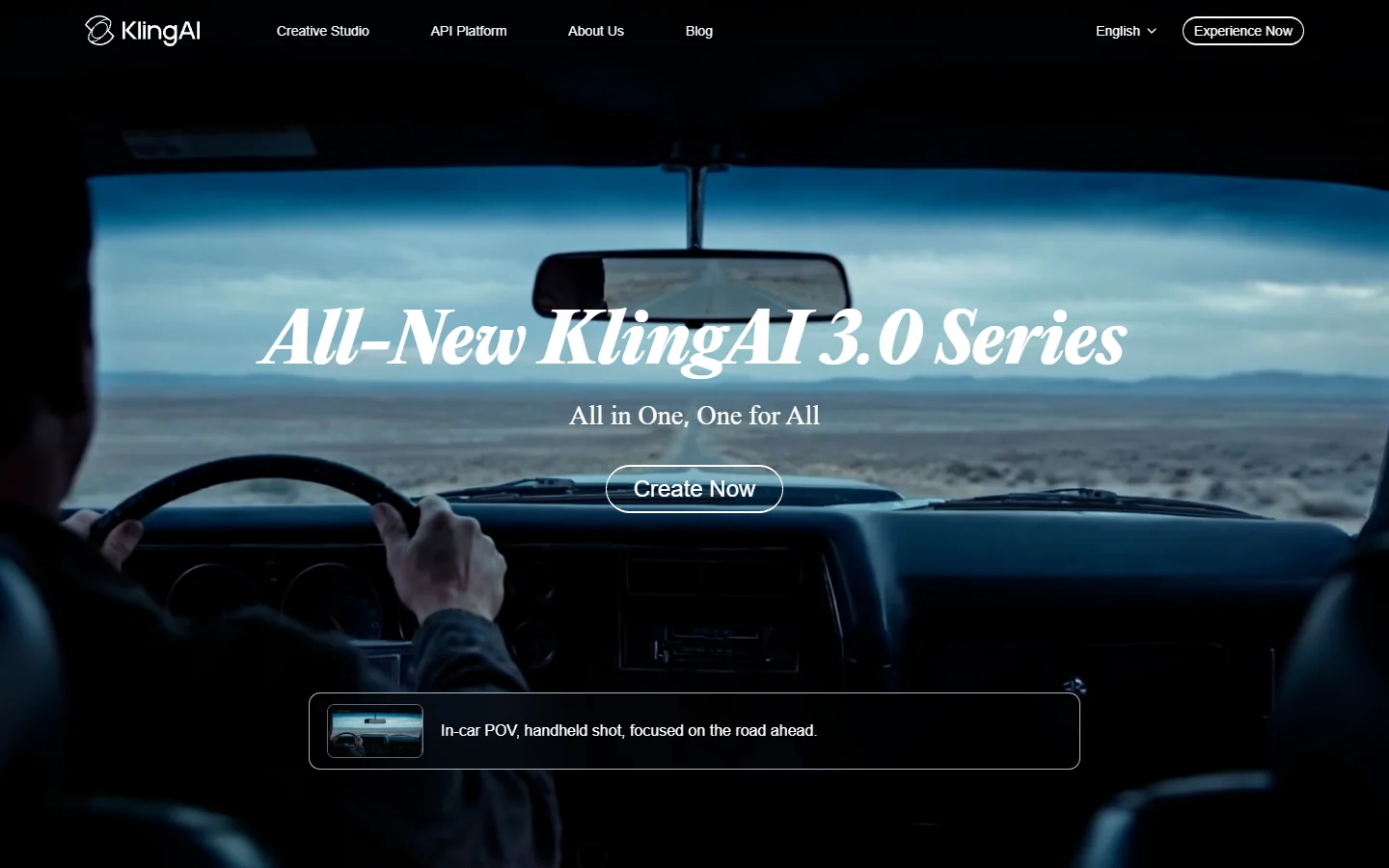
Kling from Kuaishou has emerged as one of the strongest Runway competitors for raw video quality. Kling 2.0 and the newer Kling 2.5 models handle complex prompts with realistic motion, consistent characters, and natural physics. The API is available through several aggregator platforms, making it accessible without a direct enterprise relationship.
- Strength: Character consistency and motion realism rival or exceed Gen-3 Alpha. See the Kling usage guide for setup details
- Weakness: Direct API access requires going through third-party providers; Kuaishou's own API docs are limited outside China
- Best for: Teams that prioritize output quality and can work with aggregated API access
For a deeper look at Kling's capabilities, the Kling 3 prompts guide covers effective prompt patterns for getting the most out of the model.
Luma Dream Machine: Best for Speed and Simplicity
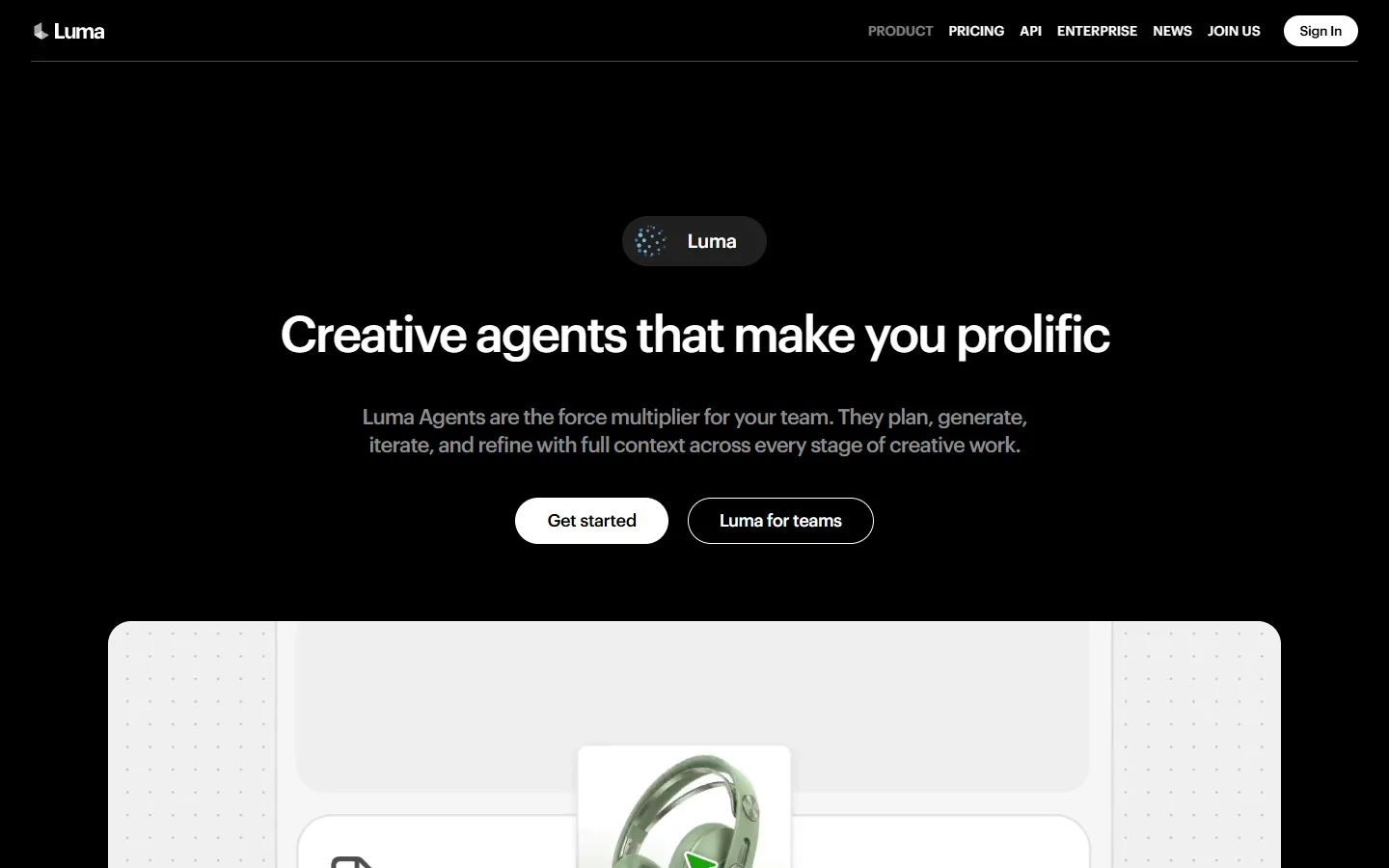
Luma AI's Dream Machine offers a clean REST API with straightforward authentication. Generation times are consistently fast, and the API supports both text-to-video and image-to-video with minimal configuration. Luma's pricing is credit-based and transparent, with no enterprise gate.
- Strength: Fast generation (often under 60 seconds for 5-second clips), clean API design suited for AI avatar and talking head videos
- Weakness: Motion complexity does not match Kling or Veo 3 on difficult prompts
- Best for: Rapid prototyping, embedded video features that need low latency
The simplicity of Luma's API makes it a good starting point for developers who want to turn text into video without dealing with complex pipeline configuration.
Pika Labs: Best for Creative and Stylized Video
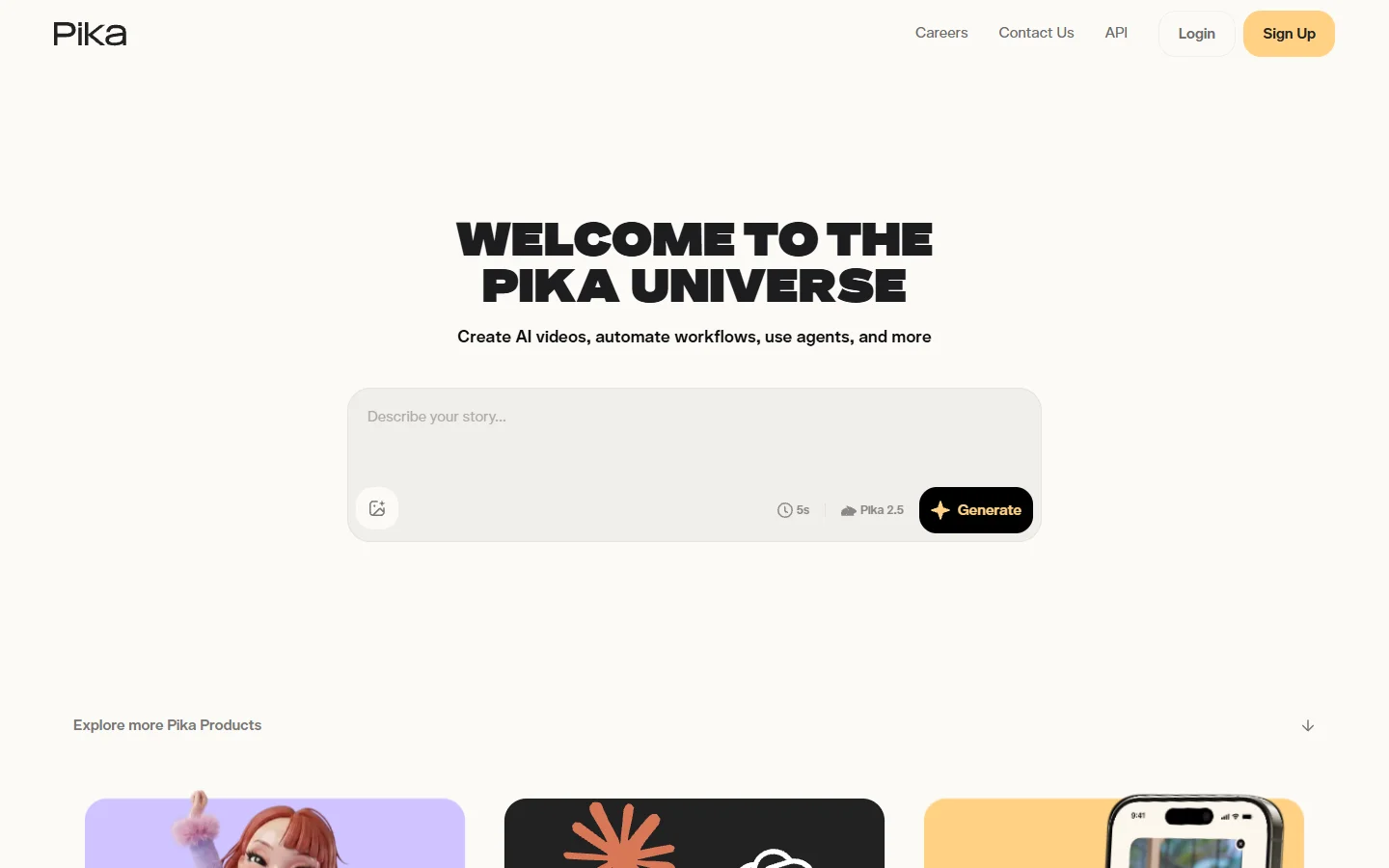
Pika has carved out a niche in stylized, creative video generation. Their API supports effects like "inflate," "explode," and style transfer that are not available from other providers. For social media content, short-form ads, and creative campaigns, Pika's unique capabilities make it hard to replace.
- Strength: Unique creative effects and style controls not found elsewhere, ideal for TikTok content creation
- Weakness: Less suited for photorealistic or long-form video
- Best for: Social content creation, creative agencies, marketing teams building AI reels and short-form video
WaveSpeed AI: Best for Multi-Model API Access
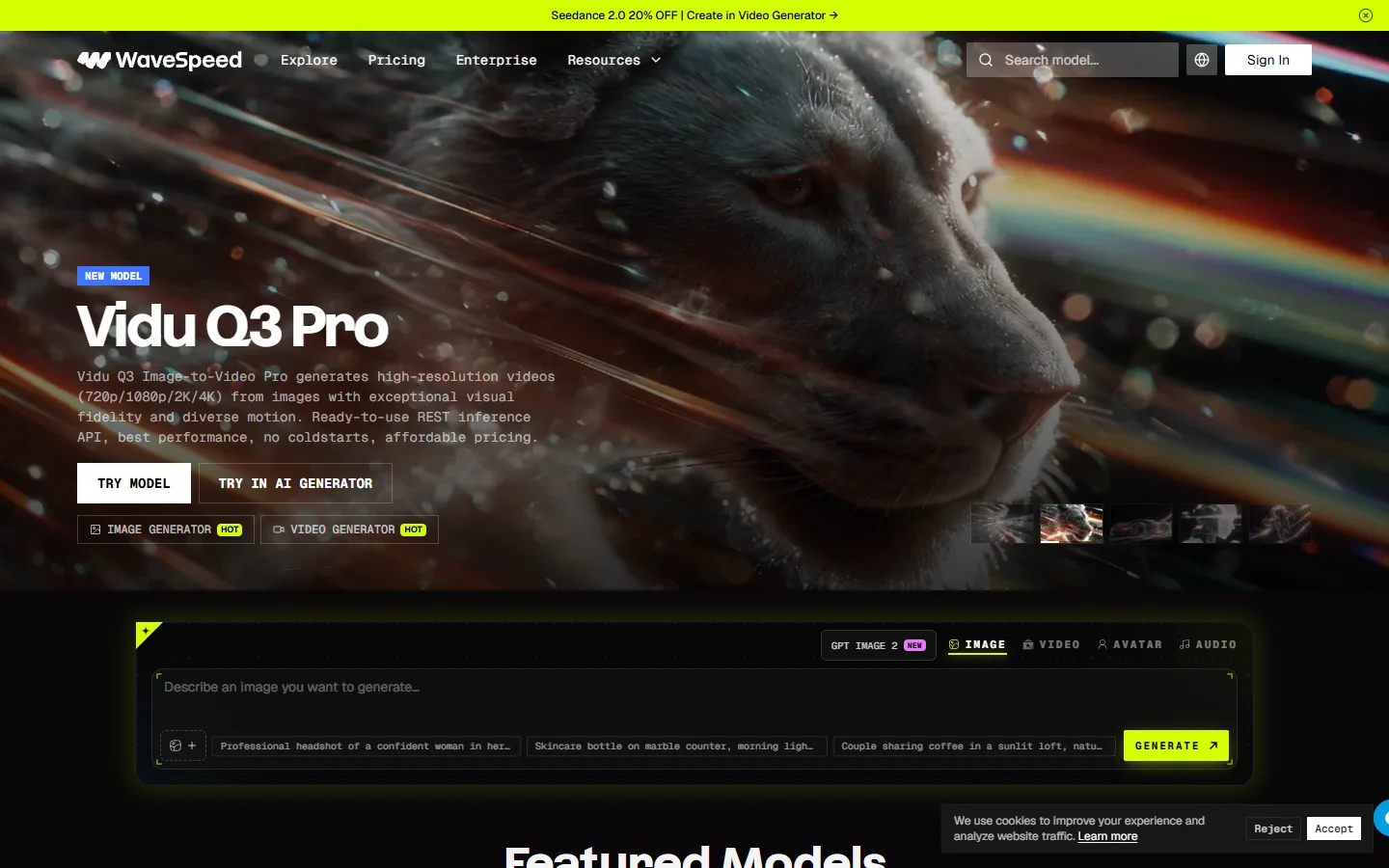
WaveSpeed takes the aggregator approach: one API, multiple models. Through a single endpoint you can access Kling 2.0, Seedance, Wan, and others. Pricing is pay-per-use ($0.50 to $2.00 per video depending on model and duration), and every account gets full API access from signup.
- Strength: Multi-model access through a single API with webhooks and async support; 99.9% uptime SLA, similar to what the BasedLabs AI API provides
- Weakness: You are dependent on their model partnerships; model availability can lag behind direct providers
- Best for: Teams building products that need to offer multiple video styles or switch models without re-integrating
The multi-model approach is similar to what wireflow.ai does for image generation pipelines, where routing across models through a single interface reduces integration overhead significantly.
Google Veo 3: Best for Photorealism and Audio
Google Veo 3 changed the landscape when it launched with native audio generation. Videos from Veo 3 include synchronized sound effects and ambient audio, which no other model offers natively. The API is available through Google Cloud's Vertex AI, with pricing based on compute time.
- Strength: Native audio generation, photorealistic output, strong prompt adherence. The Veo 3.1 overview covers the latest model improvements
- Weakness: Vertex AI integration adds complexity; pricing is not straightforward for small teams
- Best for: Production-quality video with audio, enterprise applications
For a comparison of how Veo stacks up head-to-head, the Veo 3 vs Seedance analysis provides detailed benchmarks on motion quality and prompt fidelity.
How to Choose the Right Runway API Alternative

The right choice depends on what you are building. Here is a practical framework for picking the right video generation platform:
- If you need the highest quality output: Kling 2.5 or Veo 3. Both produce results that match or exceed Runway Gen-4 on most benchmarks.
- If you need fast iteration and simple integration: Luma Dream Machine. The API is clean and generation is fast.
- If you need creative effects: Pika. Nothing else offers their style transfer and effects capabilities.
- If you need multi-model flexibility: WaveSpeed or a platform like BasedLabs that aggregates multiple providers behind a unified API.
- If you need audio with video: Veo 3 is currently the only option with native audio generation.
For teams building complex content pipelines that involve both image and video generation, an end-to-end AI image pipeline can eliminate the need to manage separate integrations for each step.
What to Look for in an API-First Video Platform
Not all APIs are created equal. When evaluating a Runway alternative, the same criteria that matter for choosing any AI tool apply here too:
- Authentication: Token-based auth with API keys is standard. Avoid platforms that require OAuth flows for server-to-server calls.
- Async support: Video generation takes 30 to 120+ seconds. The API should support webhooks or polling, not just synchronous responses.
- Error handling: Good APIs return structured error responses with retry guidance. Bad ones return generic 500s.
- Rate limits: Check whether limits are per-key or per-account, and whether burst capacity is available.
These details matter more than headline model comparisons when you are building a product that needs to work reliably at scale. The Replicat review covers how some platforms handle model routing and failover, which becomes critical once you are processing hundreds of generations per day.
FAQ
Is Runway's API publicly available?
Runway's API access varies by plan. The most advanced models (Gen-4, Turbo) are typically enterprise-gated, meaning you need to contact sales for access. Consumer plans offer limited or no API access for AI video generation.
Which Runway alternative has the best free tier?
Pika and Luma both offer free credits on signup. Pika gives enough for roughly 10 to 15 short videos, while Luma provides a similar amount. WaveSpeed does not have a free tier but starts at $0.50 per video. See also free video creation options that work without an API.
Can I use multiple video AI models through a single API?
Yes. Platforms like WaveSpeed and BasedLabs aggregate multiple models (Kling, Veo, Seedance, Wan) behind a single API endpoint. This lets you switch models without changing your integration code, which is useful for comparing video generator outputs.
How does pricing compare between Runway and its alternatives?
Runway charges per-second of generated video, with costs varying by model and resolution. Most alternatives use per-video or credit-based pricing. A 5-second clip on Runway costs roughly $1.50 to $3.00 depending on the model. WaveSpeed ranges from $0.50 to $2.00. Kling through aggregators is typically $0.80 to $1.50 per clip. See the Sora 2 vs Veo 3 comparison for more detail.
What about image-to-video capabilities?
Most Runway alternatives support image-to-video generation. Kling and Luma handle it particularly well, maintaining the composition and style of the input image while adding natural motion. This is essential for teams building video content from product images or stills.
Is the video quality of alternatives comparable to Runway Gen-4?
Kling 2.5 and Veo 3 produce results that are comparable to or better than Runway Gen-4 on most benchmarks, particularly for photorealistic content. Pika excels in stylized and creative content. The gap has closed significantly since early 2025, and the main differentiator is now pricing and API access rather than raw quality. The Veo 3 prompt guide shows what the latest models can achieve with the right input.
Do these alternatives support batch processing?
WaveSpeed supports batch submissions through their API with webhook callbacks. Luma also supports queued generation. For large-scale batch processing, using an aggregator platform that handles queuing and retries automatically is usually more efficient than building that infrastructure yourself.
Conclusion
The Runway API served as the default choice for AI video generation for two years, but the landscape in 2026 looks very different. Kling, Luma, Pika, Veo 3, and WaveSpeed each offer API access that is more open, more affordable, or more flexible than what Runway provides. The best choice depends on your specific needs: quality, speed, creative control, or multi-model access.
For most developer teams, the days of being locked into a single provider's API are over. The trend toward aggregated, multi-model APIs mirrors what happened in image generation, and teams that adopt this pattern now will have an easier time adapting as new models continue to launch.