
Almost every ad platform now ships something it calls an agent. Most of them are not agents. They are recommendation panels with a confirm button, and the human still does the deciding. The useful question in 2026 is where each tool draws the autonomy line: which decisions it makes on its own, and which it hands back to you. That framing lines up with what we have seen in how AI agents are changing the way creators research and build online.
Four decisions matter in a paid campaign: how much to spend, who to spend it on, what creative to run, and when to kill something. A tool that writes headlines is a creative assistant. A tool that reallocates budget across ad sets overnight without asking is an agent. Most products sit in between.
We went through the current crop reading permission models rather than landing pages. Native platform agents hold the most power because they hold the wallet. Independent tools have better creative range but stop at the edge of the ad account, a tension that drives the shift covered in the rise of vertical SaaS in marketing.
What actually counts as agentic advertising
An agentic advertising tool closes a loop without a human in the middle. It observes performance, decides, acts on the ad account, then observes the result of its own action. If any step needs you to click approve, the loop is open and the tool is an assistant.
Open-loop tools save you time. Closed-loop tools change the shape of the job, because your work moves from operating campaigns to setting the boundaries an agent works inside. Teams that build automated production pipelines will recognise the pattern from building AI workflows without code, where the skill becomes defining constraints rather than executing steps.

How we ranked them
Ranking is by real autonomy first, creative depth second, price transparency third. A tool that generates a thousand variants but cannot spend a dollar ranks below one that quietly moves budget every night. We ignored vendor case studies, since none are independently auditable, an issue that also shows up when evaluating AI tools for social media video.
1. Meta Advantage+
Meta Advantage+ is the most autonomous advertising system most people will ever touch, and it costs nothing beyond media spend. You set a budget, a conversion event and a creative pool, and Meta decides audience, placement and delivery.
- Meta Advantage+ - Strength: full budget, targeting and placement autonomy inside Meta · Weakness: no visibility into its reasoning, and no reach beyond Meta · Best for: advertisers already concentrated on Facebook and Instagram
The honest limitation is a black box with a house edge. Meta has no opinion about creative quality, so the pool you feed it sets your ceiling, which makes upstream production the real lever and pairs it naturally with output like AI tools for TikTok UGC ads.
Verdict: the strongest default if your spend lives on Meta, and the cheapest way to test autonomy at all.
2. Pixis
Pixis is the strongest independent option for budget autonomy across more than one channel. Its performance layer earns the agentic label because it acts on live campaigns instead of producing a report.
- Pixis - Strength: cross-channel budget and bid decisions with an audit trail · Weakness: sales-led pricing and a slow setup · Best for: consumer brands spending across several platforms
Cross-channel is where independent tools justify themselves, since Meta cannot see your Google spend. The tradeoff is integration depth, because every platform exposes a different API surface, a familiar constraint from AI orchestration APIs for production apps.
Verdict: the pick when your problem is money sitting in the wrong channel rather than weak creative.
3. Smartly
Smartly is the enterprise incumbent and behaves like one. It automates creative production and campaign operations across Meta, TikTok, Pinterest and other channels, with approval workflows built in because its customers are agencies and large in-house teams.
- Smartly - Strength: multi-market operations, brand controls, approval routing · Weakness: autonomy capped by review gates · Best for: large teams where a wrong decision is expensive
Our screenshot attempt was blocked by a bot challenge, so there is no capture here. Flagging that beats filling the gap with a generated image, the sourcing standard we applied in comparing AI image editors.
Verdict: the safe institutional choice, and the least agentic tool on this list by design.
4. Superscale AI
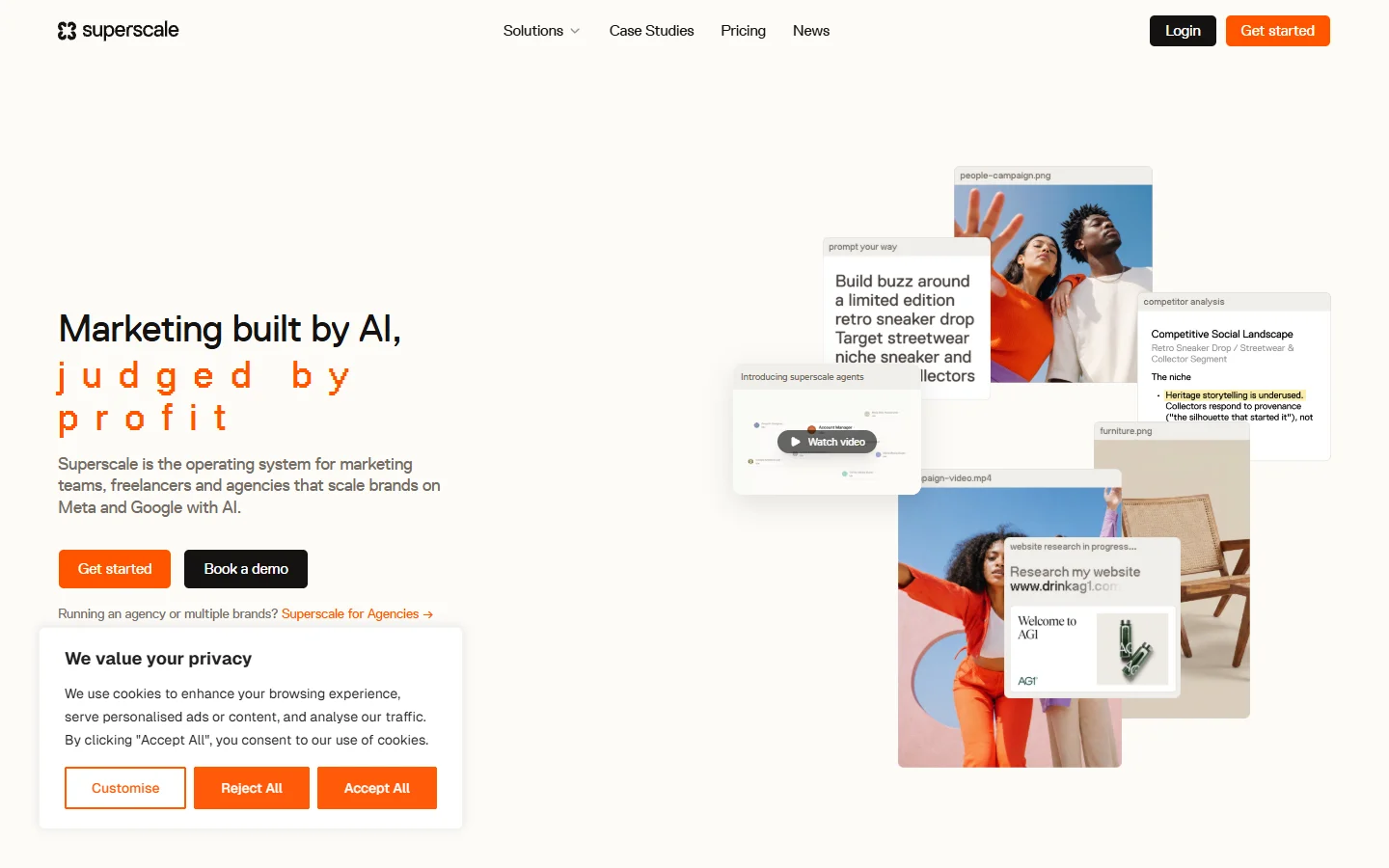
Superscale AI targets the gap platform agents leave open. Meta optimises whatever creative you give it but will not make more of it, so Superscale generates creative at volume and pushes it into Meta Ads Manager directly, which is closer to a closed loop than most independent tools get.
- Superscale AI - Strength: generation wired straight into campaign launch · Weakness: Meta-centric, so it inherits Meta's blind spots · Best for: teams bottlenecked on creative volume
Creative volume is an underrated bottleneck. Once Advantage+ is running, the number of distinct concepts you can feed it becomes the limiting factor, and teams solving that end up with something resembling batch image generation via API.
Verdict: the answer when you have budget autonomy and need more ads to feed it.
5. Madgicx
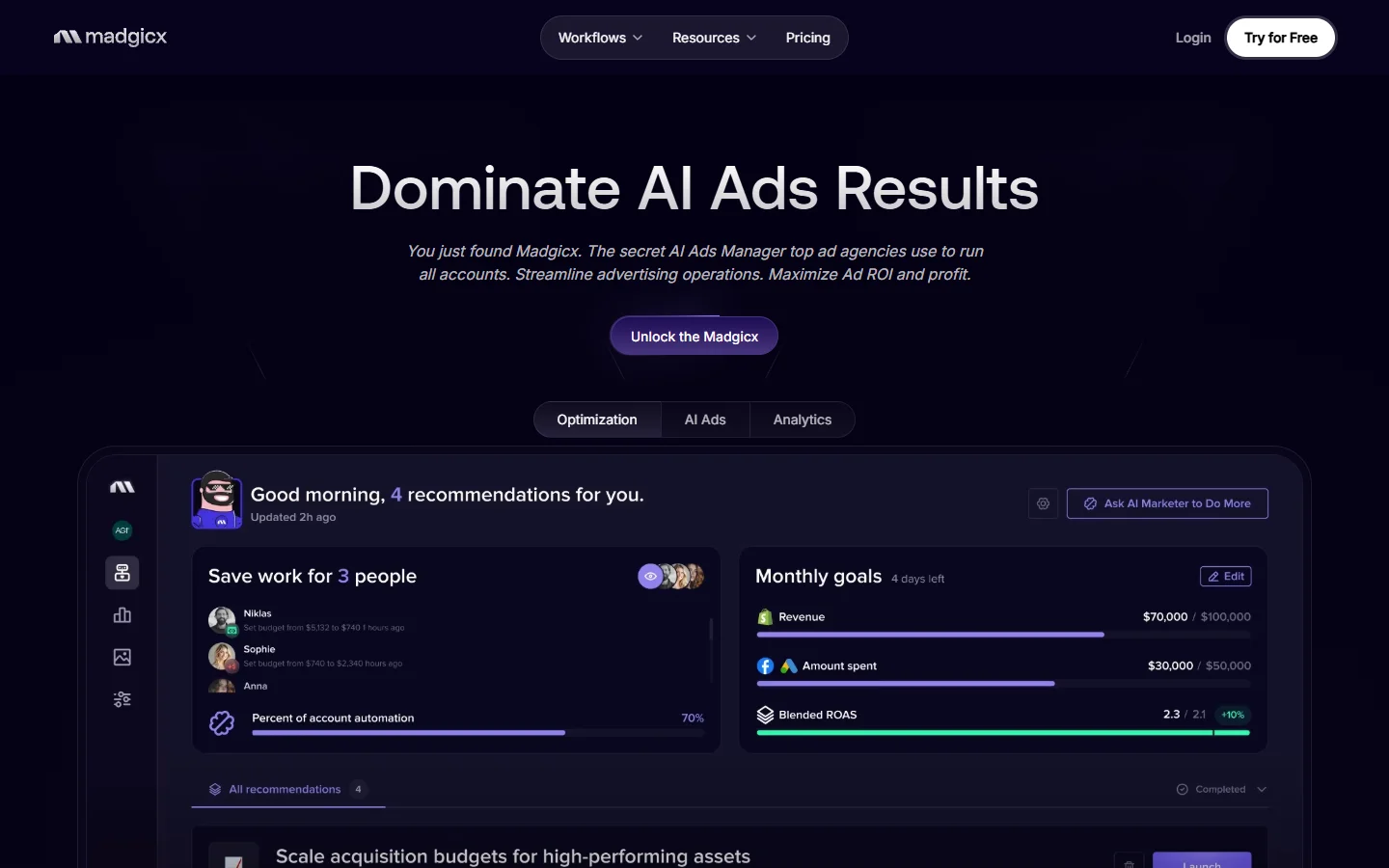
Madgicx has automated Meta buying since before the word agentic was attached to it. It offers rule-based and AI-driven budget moves, audience suggestions and creative analysis in one subscription, with published pricing rather than a sales call.
- Madgicx - Strength: published pricing, fast setup, real automated budget rules · Weakness: closer to smart rules than autonomous reasoning · Best for: ecommerce advertisers under agency scale
Verdict: the practical option for a small team without an enterprise contract.
6. Omneky
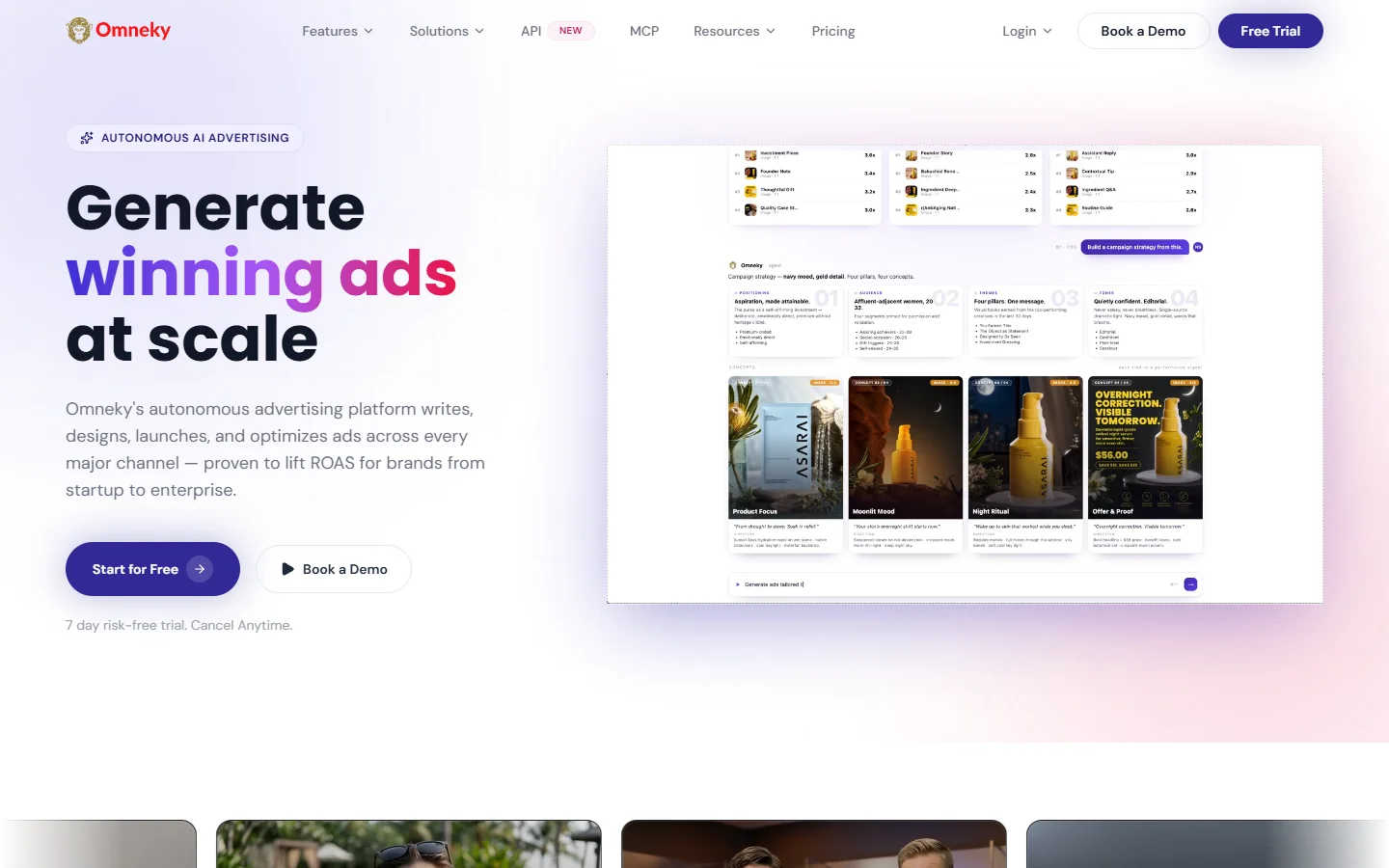
Omneky sits between creative studio and ad platform. It generates brand-consistent creative at volume, tracks which elements perform and feeds that back into the next round. Brand consistency is the differentiator, since most generation tools drift after a few dozen variants.
- Omneky - Strength: brand-controlled generation with performance feedback · Weakness: limited budget authority, so it advises more than it acts · Best for: brands with strict visual guidelines
The feedback loop matters because creative decisions get made on measured evidence rather than taste, as happens when visuals are treated as measurable assets in turning AI visuals into search visibility.
Verdict: pick it for brand safety at volume, not for autonomous spend.
7. AdCreative.ai
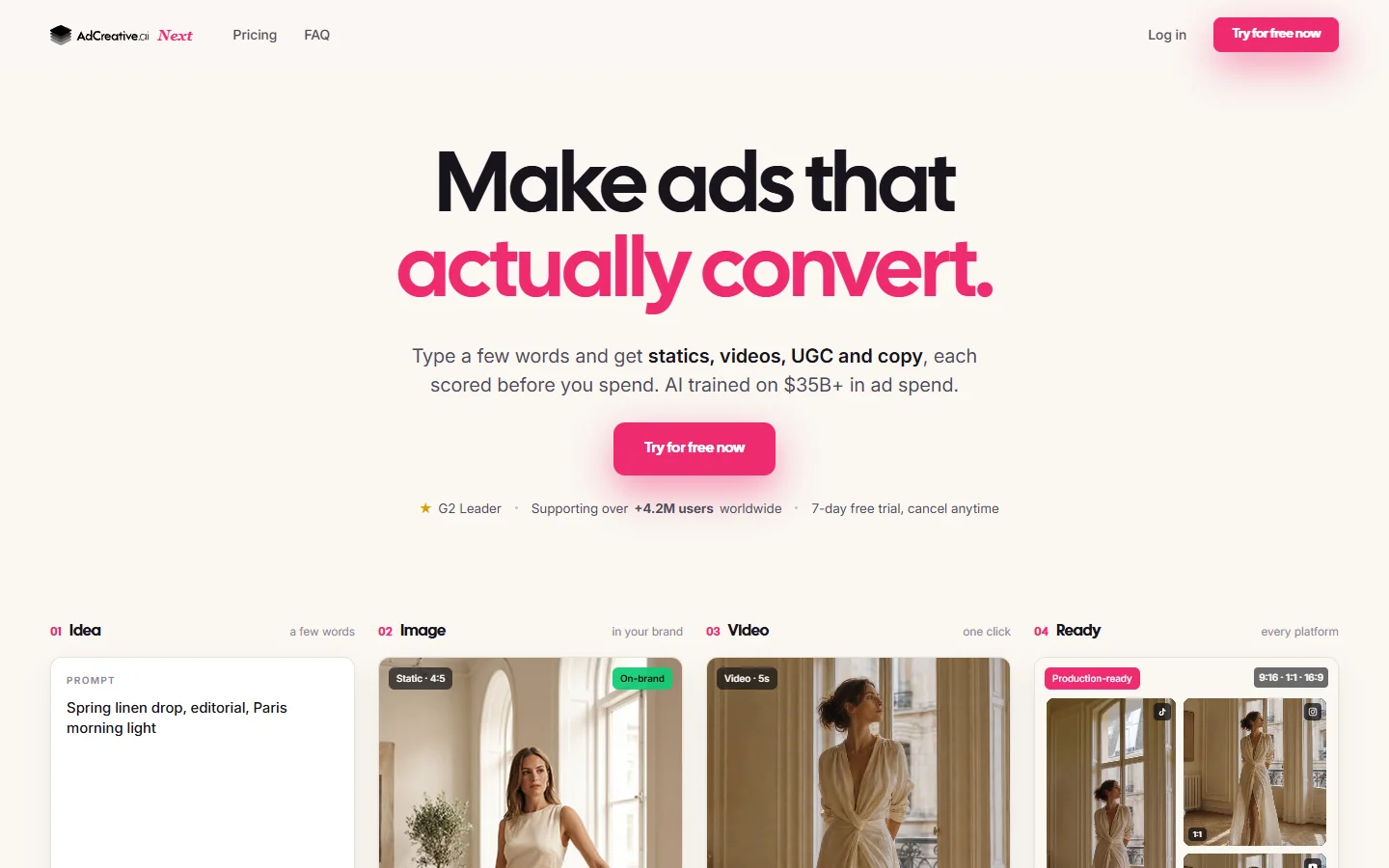
AdCreative.ai is the most widely used tool in this space and the least agentic. It produces ad variants quickly and scores them for predicted performance, but it does not touch your budget, targeting or kill decisions. It is here as a caution, because it is frequently listed as an agentic platform when it is a generator.
- AdCreative.ai - Strength: fast, cheap variants with predictive scoring · Weakness: no campaign authority, so the loop stays open · Best for: solo operators and small agencies
Verdict: a good creative generator, and not an agent.
The measurement problem nobody has solved

Every tool here reports on its own performance, which is the structural flaw in the market. The agent deciding where money goes is also the system telling you the decision worked. Meta grades Meta. Pixis grades Pixis. The same conflict appears in anything that both acts and reports on itself, including the stacks described in building AI pipelines with REST APIs.
When an agent shifts budget toward an audience that was going to convert anyway, the reported lift is real and the incremental value is zero. Holdout testing is the only honest answer, and almost nobody runs it. Budget for a holdout group before you budget for the tool.
The second gap is explanation. Few of these systems can say why they decided something in terms a human can check, which makes debugging a bad month close to impossible. Ask for decision logs during evaluation, particularly if you need accountability across content generation APIs.
How to choose
Start with where your money already sits. If most of your spend is on one platform, the native agent is your first move, and it is free. Independent tools earn their cost when spend is genuinely split.
Then be honest about the bottleneck. If your ads are fine and your allocation is bad, buy budget autonomy. If allocation is fine and the ads are tired, buy creative volume, which for many teams is now a production problem closer to making AI Instagram reels than a media buying one.
Finally, decide what an agent may do before you turn it on. Set a maximum daily spend it can move, a floor below which it cannot cut a campaign, and a review cadence. Agents behave well inside constraints, the same principle that governs headless AI workflow platforms, where a system only does what its inputs permit.
FAQ
What is an agentic advertising tool? Software that closes a decision loop on a live ad account without human approval at each step: it observes, decides, acts, then measures its own action. Tools that stop for a confirmation click are assistants, and the difference shows up in the permission model rather than the marketing copy.
Are agentic ad tools worth it for small budgets? Usually not as paid software. At low spend the native agents do most of the work for free, and a subscription tool has to beat that baseline first. The exception is when creative production is your constraint, which is closer to the toolkits in 7 AI tools for content creators chasing organic reach.
Which agentic advertising tool has the most autonomy? The platform-native agents, because they control the ad account directly. Meta Advantage+ makes budget, audience and placement decisions with no human in the loop. Independent tools trade autonomy for cross-channel neutrality, a tradeoff familiar to anyone who has compared developer-friendly AI generation platforms against a single vendor's own stack.
How do agentic tools handle creative? Some generate it, some only score it, and few do both well. Generation tools produce variants at volume while platform agents consume whatever pool you supply, which is why pipelines like those behind AI product images for online stores increasingly sit upstream of the ad account.
What should I ask a vendor during evaluation? Ask which decisions the system takes without approval, whether it can produce a human-readable log of them, and what happens to your data if you leave. Vendors who cannot answer the first are selling an assistant at agent pricing, the same directness worth applying to creative claims, as in making AI marketing visuals look human rather than generated.
The short version
The market has more agentic branding than agentic behaviour. Meta Advantage+ is the most autonomous system available to most advertisers and it is free, which makes it the correct starting point. Pixis and Superscale cover what platform agents cannot: cross-channel arbitration in one case, creative supply in the other.
Everything else here is worth buying for a specific reason rather than for autonomy. Set your constraints, run a holdout, and judge the agent on incremental results rather than the dashboard it writes about itself. That discipline applies as much to node-based AI workflow platforms as to ad buying.