

You're probably sitting on a pile of exports, logs, or customer records that feel valuable but impossible to sell cleanly. That's the right instinct. Raw rows don't sell well, buyers don't pay for mess, and the fastest path to a dead deal is trying to move a spreadsheet instead of a governed product.
How to Sell Data: The Complete Monetization Playbook
Table of Contents
- Why Selling Data Requires a Product Mindset
- Choosing Your Data Business Model
- Packaging and Protecting Your Dataset
- How SourceX Can Help
- Pricing Strategies That Avoid Undervaluation
- Finding Buyers and Closing the Sale
- Final Steps for a Sustainable Data Business
Why Selling Data Requires a Product Mindset
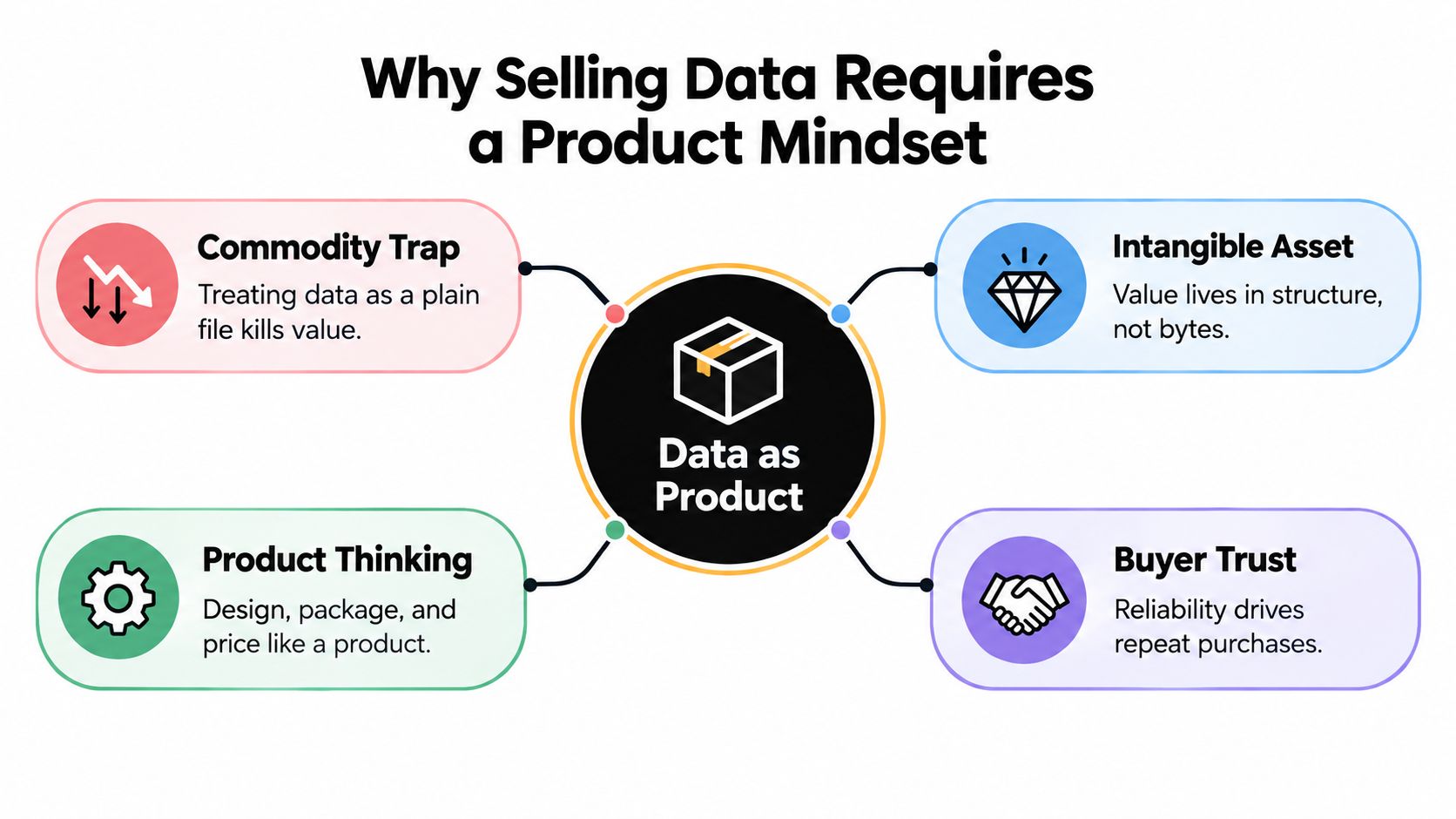
A dataset has to be sold like a governed product, because data behaves like an intangible asset: it can be reused, combined, and applied repeatedly to create business value. The OECD's framework treats data as an input to production, which is the right starting point for monetization. If your offer is only a file, you have framed it too narrowly. Buyers want a result, such as better targeting, stronger forecasting, cleaner benchmarking, or model training that improves decisions. OECD's framework for measuring data as an asset
Stop Selling Volume
The market does not reward undifferentiated bulk. It pays for reliable, usable data with provenance, documentation, quality controls, update frequency, access format, and proof that the customer gets a return. The Australian Bureau of Statistics has also treated data as a measurable asset in national accounts work, which reinforces the same commercial point, data earns value when it is structured, governed, and fit for use, not when it is dumped as a raw export.
Practical rule: If you cannot name the business outcome, you do not have a product yet.
That shift is uncomfortable but necessary. Sell a controlled mechanism that helps a buyer do something faster, cheaper, or with less risk. Every dataset needs a use case, a buyer profile, and a clear promise. If you cannot define those three things, you are still in data hoarding mode.
Package Outcomes, Not Files
The strongest commercial offer ties the data to a specific business outcome. That can be audience activation, demand forecasting, fraud detection, or model training. The OECD's review of personal-data economics makes the pricing problem clear, there is no universal market price for data, and most data never trades openly at all. Buyers judge value by scarcity, freshness, accuracy, exclusivity, permitted use, and delivery method, not by file size. OECD's review of personal-data economics
That changes the offer design. Name the decision the buyer wants to improve, the data elements that support that decision, and the workflow where it plugs in. If the buyer cannot see how the data fits their stack, they will treat it like a commodity and push the price down. If they can see a measurable use, they will pay for certainty.
Choosing Your Data Business Model
The wrong model kills good data. I've seen teams price a high-value dataset like a one-off file when they should've sold a recurring feed, and I've seen them overcomplicate a small dataset with enterprise licensing when a simple transaction would've closed faster. The model has to match how often the buyer needs the data, how sensitive the data is, and how much support you're willing to provide.
Direct Sales Versus Marketplaces
Direct sales give you control. You set the terms, shape the scope, and keep more of the economics, but you also carry the burden of prospecting, negotiation, compliance, delivery, and support. Marketplaces reduce friction and can help you reach buyers faster, but they usually compress differentiation. That's fine for a standardized dataset with low support needs. It's a bad fit for sensitive, high-trust, or operationally complex data.
Here's the clean comparison:
- Direct sales — Best For: High-trust, specialized, or sensitive datasets · Revenue Type: One-time deal or negotiated recurring contract
- Marketplace listing — Best For: Standardized datasets with clear demand · Revenue Type: Platform-driven transaction revenue
- Licensing — Best For: Data that can support repeated use or embedded workflows · Revenue Type: Recurring license fees or enterprise agreements
- Synthetic data generation — Best For: Use cases where original records are too risky to share · Revenue Type: Project fees, subscriptions, or bespoke contracts
The direct-sales path pairs well with custom use cases and strong relationships. The marketplace path fits when your dataset is easy to evaluate without deep explanation. Licensing works when the buyer wants ongoing access or the data becomes more valuable as a workflow ingredient. Synthetic data can work when the underlying records are too sensitive to release directly and the buyer mainly needs realistic structure, not the original source material.
Licensing Is Usually the Better Default
If your data has continuing utility, licensing is often the smarter move. You keep the asset, define usage limits, and create room for repeat revenue. That matters because most data value shows up over time, not in a single handoff. Licensing also lets you separate the right to use from the right to resell, which is where too many sellers create future headaches for themselves.
For a practical starting point, compare your dataset against the buyer's operating rhythm. Daily operational decisions point toward API access or recurring feeds. Project work points toward a one-time file or a fixed-term license. And if your buyer wants training data, make sure the use case, deletion expectations, and downstream rights are spelled out before you take a cent. If your data comes from web collection or automated extraction, a clear technical delivery layer matters too, and a resource like this guide on web scraping API design can help you think through the operational side.
A buyer who needs your data every week should rarely be sold a static CSV once.
Pick the Model That Matches Risk
The more sensitive the data, the more the commercial model needs to protect you. Direct sale of raw personal data is where sellers get trapped, because a one-time transaction creates a permanent exposure if the buyer mishandles it. Licensing and controlled delivery are usually safer because they let you define permitted use, retention, deletion, and access scope. If the data is only valuable when combined with your interpretation, sell the analysis layer and keep the raw data behind the curtain.
The hardest truth is this. The best model is usually not the easiest one to explain. It's the one that preserves control while letting the buyer get value fast enough to renew.
Packaging and Protecting Your Dataset
Raw data is not saleable until you make it legible. Buyers do not want to reverse-engineer source systems, guess what a field means, or find out after purchase that half the rows are unusable. They want a product they can trust, and trust comes from structure, not hope. Start with a narrow schema, documented definitions, and a clear statement of what the dataset covers and what it does not.
Build the Data Contract First
A data contract is the right place to start. Define field names, provenance, quality thresholds, refresh cadence, historical depth, delivery method, retention, deletion procedures, and permitted uses. If a buyer has to negotiate those details after seeing the first sample, your process is too loose. The contract is not paperwork, it is the product spec.
That discipline protects margin. Teams that publish a usable data product sheet avoid endless custom explanations, mismatched expectations, and support tickets that should never have existed. The sheet should cover coverage, timestamps, known bias, missingness, validation tests, sample records, and service levels. Buyers pay more when they can see what they are getting and how it was produced.
Practical rule: If the buyer cannot audit the value quickly, they will assume the price should be lower.
Clean the Asset Before You Monetize It
Remove direct identifiers, generalize quasi-identifiers, and test linkage risk before the data leaves your control. That matters even more when the records include behavioral logs, media, location, or anything else that can be tied back to a person. The strongest commercial product is often not the raw record. It is the aggregated trend, benchmark, clean-room output, or derived metric. Those forms reduce exposure while still giving the buyer something useful.
A few things should happen before release:
- Inventory every field and source. Know exactly where each attribute came from and why you are allowed to use it.
- Separate identifiers from derived metrics. Do not mix the two in the same export or API response.
- Generalize or suppress risky combinations. Rare attributes are where re-identification risk spikes.
- Document opt-out and deletion workflows. Buyers need to know how privacy requests flow through downstream copies.
- Log every export or API call. If you cannot trace distribution, you cannot defend it.
GDPR exposure is real, with fines that can reach 4% of global annual revenue or €20 million, whichever is greater. California privacy law gives consumers rights including access, deletion, correction, and opting out of sale. Those legal realities make privacy preparation a sales function, not just a legal one. A buyer who sees strong controls is less likely to stall on diligence. For teams wiring private business data into AI assistants, this guide to connecting Claude and ChatGPT to private business data with MCP shows how controlled access works in practice.
Treat Documentation as Part of the Product
Documentation sells because it lowers buyer effort. If your dataset is clean but undocumented, the buyer has to spend time decoding it, and that cost comes straight off your price. If your provenance is explicit, your update cadence is consistent, and your permitted uses are clear, the buyer can move faster and commit with less internal friction.
That is the packaging advantage. You are not just shipping data, you are shipping confidence. Confidence turns a file into a commercial asset.
How SourceX Can Help
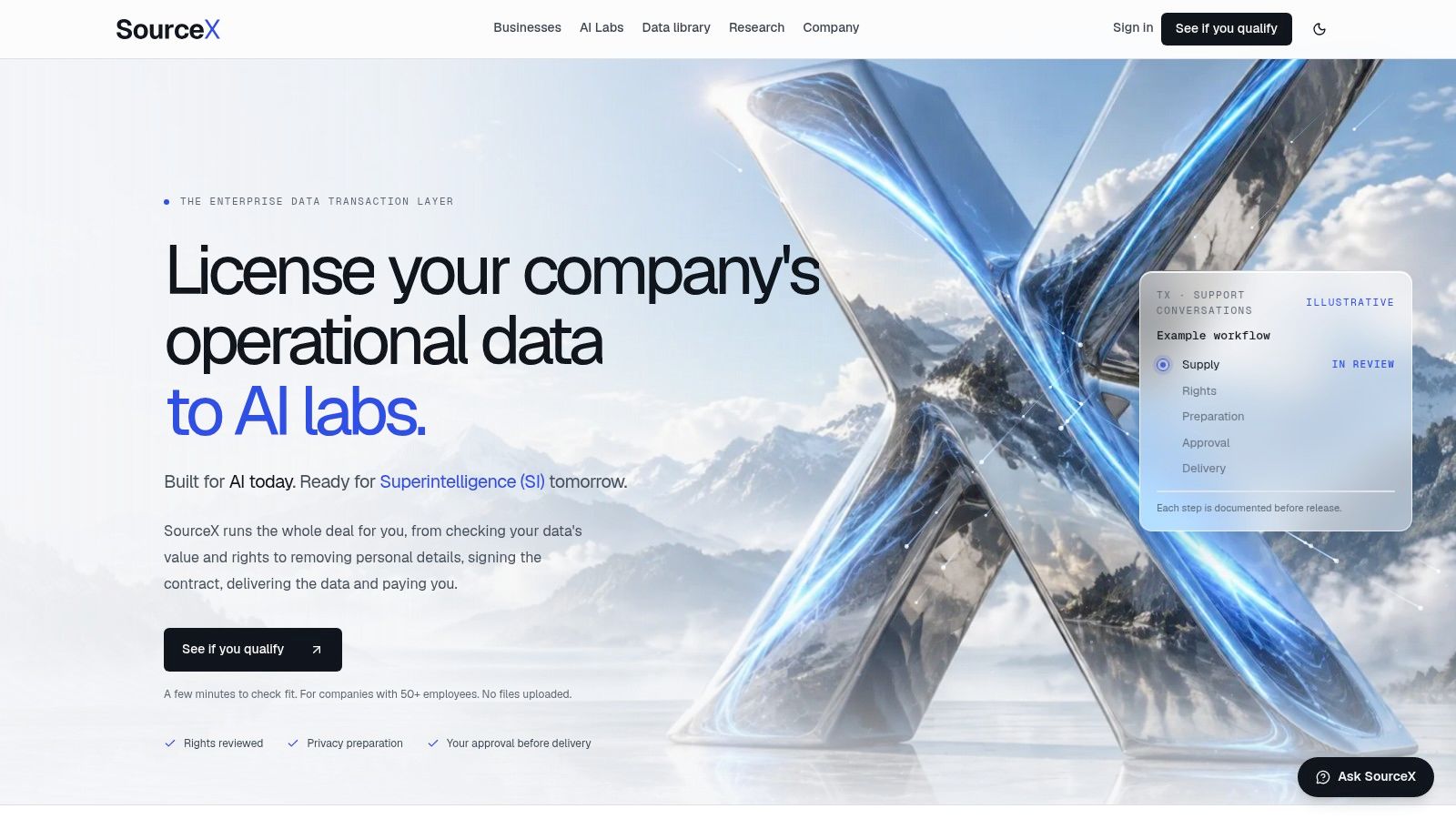
SourceX is useful when you need to commercialize data without losing control of the asset. It's built as an enterprise data transaction layer for licensing operational datasets to AI labs and other buyers, which makes sense if you're dealing with system exports, usage logs, or other records that need rights review, deidentification, contracting, and delivery in one governed workflow. You can review its how to sell data resource if you want a practical entry point into that licensing motion.
Where It Fits
The strongest use case is when the buyer wants real-world operational data, but you can't afford sloppy rights handling. SourceX standardizes sourcing, rights validation, deidentification, contracting, delivery, and payment, and the supplier approves each step before anything moves forward. That matters because many data sellers underestimate how much time gets burned stitching those tasks together across legal, technical, and commercial teams.
It also solves a common packaging problem. Enterprise exports are usually fragmented across tools like Zendesk, Salesforce, GitHub, Jira, SharePoint, and Google Workspace. A structured inventory that summarizes source, depth, fields, and availability is more useful than an unreviewed dump. If your dataset needs a private inventory, a rights packet, and a controlled buyer review, this kind of workflow is the right fit.
Why It Beats a Loose Marketplace Deal
The big advantage is control. Nothing is shared until authorization is explicit, scope is embedded in the agreement, and the evidence packet is assembled before release. That lowers the chance of accidental over-sharing and makes the commercial offer easier to defend internally. It also helps when the buyer wants permanence and clarity, not just access.
That said, it's not the right answer for every seller. If you're selling a lightweight, low-risk dataset with minimal support requirements, a simpler route may be enough. But if the data is operational, sensitive, or tied to rights complexity, a controlled licensing layer is the safer move. Use a platform like SourceX when the product isn't just the data, it's the governed transaction around it.
Pricing Strategies That Avoid Undervaluation
Most data gets underpriced because sellers confuse volume with value. Buyers don't pay more just because you have more rows. They pay for cleaner provenance, better accuracy, faster refresh, clearer rights, and fewer headaches. If you price from fear, you'll invite haggling. If you price from evidence, you'll filter the wrong buyers out early.
Start With Tiers
The smartest structure is a tiered offer. Give buyers a low-friction sample or sandbox so they can test the dataset, then offer a recurring feed or API for operational use, then reserve enterprise licensing or interpretation for larger buyers. That structure works because it lets the buyer self-select based on seriousness and budget. It also protects your time, since tire-kickers often disappear once they see the difference between a demo and a production-ready dataset.
A good tier system usually separates three things:
- Sample access. Small, bounded, and easy to evaluate.
- Operational access. Recurring delivery for teams that need the data in workflow.
- Enterprise rights. Higher-touch use with stricter support, legal review, and integration.
The point isn't to overwhelm buyers with options. The point is to stop racing to the bottom before the buyer has even understood the value.
Publish the Sheet Buyers Wish They Had
A data product sheet should read like a buyer's due-diligence shortcut. It needs coverage, timestamps, missingness, validation results, permitted uses, service levels, and refund terms. If you can show how the dataset was checked and how often it updates, you've already answered the questions that stall most negotiations. Buyers distrust vague quality claims, so make the quality visible.
The reason price negotiation feels so hostile is that many buyers don't trust what they can't inspect. A recent survey of 171 data buyers and vendors found that 58% of buyers considered price negotiations a major onboarding barrier, while poor data quality and poor customer service were also major challenges. Earlier measurement of 213,964 data products found that most products were free or had no fixed price, with the median price around $1,400 per month for live data and $2,200 for one-off static data, and observed prices reaching $150,000 per month. Neudata's 2025 data industry survey report
Buyers negotiate hardest when they don't understand the quality story.
Price Against Value Perception
A dataset's price should reflect how much operational pain it removes. If the buyer can use your data to make decisions faster, reduce manual work, or avoid risky alternatives, you're not pricing a file, you're pricing avoided friction. That's why a stronger price signal often comes from the buyer's workflow than from your storage costs. Scarcity, exclusivity, freshness, and permitted use all justify premium pricing when they're real and documented.
Avoid the reflex to start low and “earn the right” to charge more later. That usually just anchors you too cheaply. Instead, set a price that reflects the quality of the product, then use the sample, the documentation, and the controls to support it. If the buyer wants a discount, make them explain which part of the value they're removing.
Finding Buyers and Closing the Sale
The buyer isn't just shopping for data, they're buying confidence that the data will survive legal review, technical integration, and internal scrutiny. That means your distribution channel, your sample experience, and your contract all have to line up. If one part is sloppy, the whole deal slows down.
Choose the Channel That Matches the Deal Size
Marketplaces help when speed matters more than control. They reduce friction, shorten the path to discovery, and can be useful for standardized assets. Direct enterprise sales are better when the dataset is sensitive, high-value, or complex enough that the buyer needs real explanation. The larger the contract, the more likely the buyer will care about provenance, permitted use, delivery reliability, and support.
That's why the close should never be just “send the file.” It should be “confirm the use case, validate the sample, sign the license, and deliver through a secure channel.” If you treat the dataset like a commodity after the buyer has seen the value, you create the exact distrust you were trying to avoid.
Use a Sandbox Before Final Delivery
Buyers need to test. Give them a sandbox, a sample environment, or a limited preview that lets them validate fit without exposing your full asset. The point isn't to be generous, it's to reduce uncertainty. Once they can see the fields, check the structure, and verify that the data behaves the way you said it would, the sale gets much easier.
The legal side matters just as much as the sample. A strong data usage agreement should define permitted use, restrictions on redistribution, security standards, retention, and deletion. If the data will power downstream products, make sure the contract says what happens when the buyer's use case changes. For a deeper look at contract discipline in AI and data deals, the article on AI content deals and real contracts is a useful companion read.
Close With Delivery Discipline
Secure APIs, encrypted downloads, and controlled access portals all work if they're paired with clear instructions and fast support. The buyer should never have to guess how to ingest the data or what to do if the schema changes. Every extra question during handoff makes the product look less mature.
Closing rule: The sale is not done when the buyer says yes. It's done when the buyer can use the data safely, repeatedly, and without chasing you for basics.
Final Steps for a Sustainable Data Business
A data sale is the start of an operating relationship, not the end of a transaction. If you want recurring revenue, you need version control, quality checks, support, and a privacy posture that stays current as rules change. The seller who wins long term is the one who behaves like a product team, not a one-time broker.
Build for Versioning and Support
Versioning matters because buyers build on your data. If you change a schema without warning, you break their workflows and damage trust fast. Keep release notes, maintain backward compatibility where you can, and tell customers when fields are deprecated or refreshed. That kind of discipline is boring, and it's also what makes renewals possible.
Support is part of the product. Buyers need someone who can answer questions about ingestion, field meanings, update cadence, and access issues. If you can't support the integration, you don't have a mature data business. You have a one-off transfer.
Keep Compliance Operational
Privacy compliance isn't a box to tick once. It's an operating requirement. Keep your lawful basis, permissions, opt-outs, deletion paths, and buyer restrictions documented and current. If the dataset changes, rerun the risk review. If the use case changes, recheck the permissions. If the buyer wants broader rights, renegotiate instead of improvising.
Many sellers get complacent and pay for it later. They assume a good first sale means the data is safe forever. It doesn't. Data rights, privacy obligations, and retention rules all shift with the way the asset is used. The business that survives is the one that treats governance as a live function.
Launch With a Narrow, Defensible Offer
Don't start with your messiest dataset. Start with the one that has the clearest provenance, the cleanest structure, and the easiest buyer story. Get one product right, then expand. That gives you a repeatable playbook for scope, documentation, pricing, delivery, and support. It also keeps you from learning hard lessons on your most sensitive asset.
If you're ready to turn a dataset into a real business, stop thinking like a file seller and start thinking like a product owner. Build the use case, tighten the rights, document the value, and launch with a governed offer you can stand behind. If you want an execution layer for AI images, videos, and content workflows while you build the commercial side of your data business, explore BasedLabs at the right moment and use it where visual production can help your go-to-market.