

Virtual paralegal services can reduce legal support costs by 40-60% while maintaining quality, but only when the engagement has clear supervision boundaries and auditable workflows. The savings disappear when attorneys must repair preventable errors, chase missing information, or remediate security failures.
Can you get high-quality legal support without the overhead of in-house staffing? Yes, but the better question is whether your team can delegate work without delegating professional responsibility. Most discussions about virtual paralegals start with price, flexibility, or staffing capacity. Those matter, but they aren't the primary control point.
Weak supervision is the hidden risk. A remote professional may be highly capable and still create exposure if nobody has defined what they may prepare, what they may access, which deadlines require verification, and when a lawyer must approve the work. Geography isn't the deciding factor. An unmanaged workflow is.
The Bureau of Labor Statistics reported approximately 404,900 paralegal and legal-assistant jobs in 2025, with a median annual wage of $62,890. It projects little or no net employment change from 2025 through 2035, while estimating roughly 40,800 openings each year during that period. That stable employment picture combined with substantial replacement demand helps explain why remote and outsourced providers can draw from an established professional labor pool. (Bureau of Labor Statistics overview of paralegals and legal assistants)
A safe program treats virtual support as a controlled legal-operations system, not a cheaper inbox. You need defined task tiers, restricted access, documented instructions, quality checks, and lawyer review at the points where legal judgment or client responsibility enters the process.
Table of Contents
- Introduction to Virtual Paralegal Services
- What Virtual Paralegal Services Actually Are
- Benefits, Risks, and Cost-Savings Models
- How LatHire Can Help
- Compliance and Regulatory Considerations
- How to Evaluate and Hire Virtual Paralegal Providers
- Sample Contract Clauses, SLAs, and Next Steps
Introduction to Virtual Paralegal Services
Virtual paralegal services connect law firms, corporate legal departments, and legal-service organizations with qualified professionals who work remotely. The arrangement may involve an independent contractor, a dedicated outsourced team, or a managed provider that handles recruiting, supervision, technology, and administration.
The useful distinction isn't whether the paralegal sits in your office. It's whether the work moves through a reliable system. A remote professional using a secure document platform, matter-management software, video conferencing, and approved communication channels can support a firm effectively. A person with broad access, unclear instructions, and no documented review path can create trouble from any location.
Law firms remain the largest employing sector for paralegals, and the BLS describes their work as including file organization, legal research, and document preparation. Those responsibilities translate well to virtual delivery when the firm separates administrative execution from legal judgment. (Bureau of Labor Statistics description of paralegal work and employment)
Practical rule: Delegate the process, not the decision.
A virtual paralegal may prepare a chronology, organize discovery, assemble a filing packet, or identify dates in a pleading. The supervising lawyer remains responsible for determining whether the chronology is complete, whether the filing satisfies jurisdiction-specific rules, and whether the extracted dates are correct.
That boundary also changes how you evaluate cost. A low hourly rate isn't a saving if the attorney spends excessive time correcting work. The right measurement is workflow performance, including turnaround time, rework, filing-error rate, utilization, and attorney-review time. Teams should measure those indicators by matter type instead of relying only on hours worked.
Virtual support is especially useful when demand fluctuates. A litigation team may need document organization and discovery assistance during a concentrated phase, while a corporate legal department may need recurring entity-management, contract-administration, or compliance-calendar support. In both situations, the engagement should begin with a defined scope and a review protocol.
The central decision is therefore operational. Can your team identify repeatable tasks, restrict access to what the worker needs, provide usable instructions, and verify the output before it reaches a client, court, opposing counsel, or regulator? If the answer is yes, virtual paralegal services can extend capacity without requiring every support need to become a permanent office-based role.
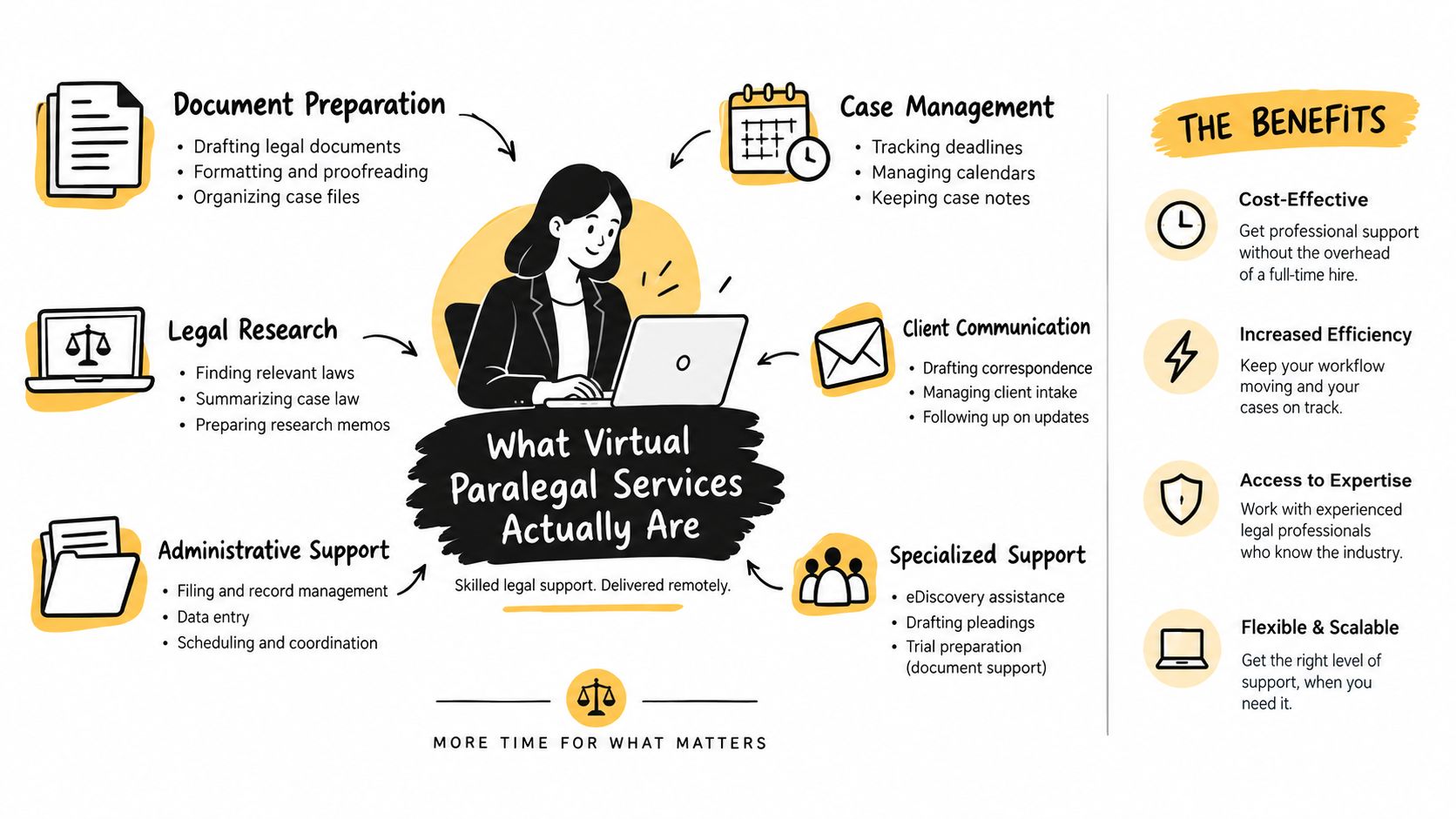
What Virtual Paralegal Services Actually Are
A virtual paralegal is a legal-support professional who performs defined paralegal or legal-operations work remotely. That description separates the role from two common alternatives.
A traditional staff paralegal works inside the firm's established employment and management structure, often with direct access to office systems and informal daily guidance. A general virtual assistant may handle scheduling, email, data entry, or travel without legal-specific training. A virtual paralegal occupies the middle ground, combining remote delivery with familiarity with legal documents, matter workflows, deadlines, research, and practice-management requirements.
The distinction matters because legal work has consequences that ordinary administration doesn't. A calendar entry can affect a filing deadline. A missing exhibit can undermine a submission. A poorly routed client message can expose confidential information or imply advice that no one authorized.
The work that fits remote delivery
The strongest candidates are structured, repeatable workflows with clear inputs and outputs. Common examples include:
- Client intake support: Enter information into approved forms, identify missing fields, route the intake to the responsible lawyer, and maintain a documented status.
- Document assembly: Populate approved templates, apply naming conventions, build indexes, and prepare draft packets for review.
- Calendaring: Enter dates from verified source documents, set internal reminders, and escalate conflicts or ambiguity rather than interpreting unclear deadlines.
- E-filing preparation: Confirm that a packet contains the required components, apply filing conventions, and prepare the submission for attorney approval.
- Legal research support: Locate relevant authorities or background material under a defined assignment, then provide citations and source notes for lawyer verification.
- Billing assistance: Review time and expense entries for completeness, prepare draft invoices, and flag inconsistencies without changing substantive billing decisions.
- Document summarization: Extract parties, dates, obligations, and issues from approved materials, with a lawyer checking the summary before it informs advice or strategy.
These activities can be delivered through secure cloud platforms and practice-management systems. They still require context. A paralegal preparing a discovery index needs a matter-specific protocol, not just access to a folder.
Examples across practice types
In litigation, a virtual paralegal might organize pleadings, maintain a document log, prepare a deposition-material index, and extract dates for a case chronology. The attorney should verify the chronology against the source documents and approve any deadline-sensitive action.
For a corporate legal team, the same role might maintain a contract repository, track renewal dates, prepare signature packets, and update an entity-management checklist. The paralegal can flag an approaching renewal, but a lawyer or authorized business owner must decide whether to renegotiate, terminate, or accept the current terms.
In a high-volume intake practice, the remote professional may collect facts through a standardized questionnaire and route matters based on attorney-approved criteria. They shouldn't decide whether a prospective client has a viable claim or provide a legal conclusion.
What the role isn't
A virtual paralegal isn't an unsupervised substitute for a lawyer. The role shouldn't include independent legal advice, final legal conclusions, unsupervised settlement communications, or autonomous decisions about filing deadlines and jurisdiction-specific requirements.
The most reliable providers make that separation visible in their workflow. They identify who prepares, who checks, who approves, and who communicates externally. If a provider describes the service only as “extra hands,” ask for the actual control model. A legal team is buying dependable execution, not merely remote availability.
Benefits, Risks, and Cost-Savings Models
Virtual support can add capacity without immediately carrying the full overhead of office-based staffing. It also lets a firm match support volume to matter demand. The financial result depends on the workflow around the role. Incomplete instructions, unclear ownership, and weak review can turn a virtual paralegal into a source of rework and attorney overload.
The strongest benefits are flexibility, specialization, and workflow focus. A provider can assign recurring administrative work to a dedicated professional while attorneys focus on advice, strategy, negotiations, and client communication. A corporate legal department can use the same structure during project peaks without turning every temporary need into a permanent headcount decision.
Technology can strengthen that model when the team measures it with the work. A 2023 legal-technology study reported that firms using technology worked over 25% more cases, logged 35% more billable hours, and generated 158% more firm revenue than in 2016. After adjusting for hourly-rate changes, the revenue increase was 72%. The figures do not establish that outsourcing alone caused better performance, but they support measuring throughput, attorney review time, and system use together. The same Clio's 2023 Legal Trends Report announcement reported that firms implementing online payments were paid twice as fast.
Compare the commercial models
- Hourly — Best For: Variable workloads and short assignments · Typical Range: Provider-defined hourly pricing · Cost Savings vs In-House: Compare total delivered cost, including review and rework
- Monthly retainer — Best For: Recurring intake, calendaring, or case support · Typical Range: Fixed recurring commitment · Cost Savings vs In-House: Evaluate against expected utilization and unused capacity
- Project-based — Best For: Document collections, migrations, or defined filing projects · Typical Range: Fixed project fee · Cost Savings vs In-House: Compare the fee with internal labor plus management time
- Credit or subscription — Best For: Multiple repeatable workflows across matters · Typical Range: Prepaid or recurring usage · Cost Savings vs In-House: Assess whether credits match actual demand and expiration terms
These models have no universal market rate. Pricing reflects specialization, location, technology, supervision, and scope. Give each provider the same work sample and require an itemized estimate. A low headline price may exclude quality review, urgent requests, secure-system access, or replacement coverage.
Price the failure modes
Evaluate a controlled workflow against an uncontrolled workflow, not a virtual worker against an employee.
Poorly scoped engagements create duplicated instructions, missed escalations, rejected deliverables, and excess attorney review. Security gaps create separate costs, including incident response, client notification, access remediation, and reputational harm. A provider that cannot explain permissions, review steps, or offboarding is not a low-risk option, regardless of its fee.
Weak supervision is the hidden cost to control. Assign every task an owner, a reviewer, an approval threshold, and an escalation route. Let the virtual paralegal prepare work within documented boundaries. Require review for client-facing communications, deadline-sensitive items, unusual exceptions, and anything involving legal judgment. Sample routine work at a defined cadence, record defects by category, and adjust the checklist when the same error recurs.
Use this financial test:
- Define the recurring tasks and expected output.
- Estimate attorney time needed to review acceptable work.
- Track corrections and rejected deliverables during a pilot.
- Add software, onboarding, supervision, and contingency costs.
- Compare the total with the internal alternative.
The cheapest provider is rarely the one with the lowest invoice. Choose the provider that produces reviewable work without creating a second management job.
How LatHire Can Help
LatHire can be relevant when a company needs help sourcing and managing remote professionals rather than searching for individual freelancers. It connects U.S. and Canadian companies with pre-vetted Latin American talent across technology, marketing, sales, and operations, and its stated service includes AI assessments, skills evaluations, human-led background checks, HR support, international payroll, benefits, and legal-compliance administration.
For a legal team, the useful question is fit. LatHire's model may help with recruiting coordination, cross-border administration, time-zone alignment, and flexible engagement structures. It doesn't remove the firm's duty to define permitted tasks, control access, supervise work, or verify legal output.
Review candidates for practice-area experience, familiarity with your case-management system, written communication, and willingness to work inside firm-managed tools. Ask how the platform handles confidentiality, subcontractors, device controls, offboarding, conflicts checks, and replacement coverage. Treat claims about speed or savings as commercial assertions to validate during a pilot, not as substitutes for your own measurements.
A provider directory or service page covering virtual legal assistants can help you compare the role against your actual workload. LatHire is a reasonable option when you need a repeatable recruiting and administration layer. It's less suitable if you want a provider to make legal judgments or assume the supervising lawyer's responsibilities.

Compliance and Regulatory Considerations
Who carries the legal responsibility when a virtual paralegal makes a mistake? The answer does not change because the worker is across town, across a border, or on another continent. Under ABA Model Rule 5.3, the supervising lawyer remains responsible for a nonlawyer assistant's conduct, including remote work. The lawyer must give appropriate instruction and supervision and remains accountable for conduct that would breach professional duties if performed personally.
Weak supervision creates the hidden risk in a virtual paralegal program. Before assigning work, document the matter, approved source materials, required output, escalation triggers, reviewer, deadline, and approval required before release. Cross-border delivery also requires attention to data location, subcontractors, local privacy rules, conflicts procedures, and professional-conduct requirements. Geography changes the control environment, not the firm's duties.
Assign tasks by risk tier
Use three practical tiers:
- Tier one, procedural execution: File naming, data entry, document indexing, routine billing support, and completion of approved templates. Once the workflow is stable, supervisors can use sampling and exception review.
- Tier two, fact-dependent preparation: Chronologies, discovery organization, intake summaries, research memoranda, and draft client communications. A designated lawyer or senior professional should review the work before it guides a matter or reaches a client.
- Tier three, legal judgment or external consequence: Legal conclusions, settlement communications, filing deadlines, jurisdiction-specific requirements, privilege decisions, and legal advice. These tasks require attorney control and documented sign-off.
Risk depends on the consequence of an error and the judgment required, not merely on the task title. A calendar entry may look administrative until it controls a court deadline. Once it can affect a filing, client right, or legal position, verification becomes mandatory.
An NDA isn't a security program
A confidentiality agreement cannot control a personal laptop, a misdirected email, a shared account, or retained access after termination. The ABA's professional-conduct framework requires reasonable efforts to prevent unauthorized disclosure of client information. The firm therefore needs controls it can test, document, and enforce. See Guidance on remote paralegal security and client files for practical issues that remote work can create.
Require firm-managed accounts, multi-factor authentication, least-privilege access, encrypted document systems, approved devices, logging, secure networks, incident reporting, and immediate access revocation. Confirm where data is stored, which vendors or subcontractors can access it, how conflicts are checked, and how retention and deletion work.
AI requires the same delegation discipline. Appropriate uses can include extracting dates and parties, preparing matter summaries, prioritizing tasks, drafting routine communications, and converting approved templates into first drafts. A supervising professional must verify legal conclusions, deadlines, privilege treatment, jurisdiction-specific requirements, and factual accuracy before release.
The adoption numbers make governance urgent. Survey evidence reported that 79% of legal professionals used AI in 2024, while earlier survey data found 19% of lawyers already using AI and 51% planning to use it, indicating rapid adoption without proof that governance has kept pace. The ABA Journal also described uses involving document, contract, agreement, and filing summaries. (American Bar Association Journal coverage of legal AI adoption)
Put the controls into the engagement contract. Cover data use, confidentiality, AI restrictions, source traceability, retention, access logs, incident escalation, and human review. Automated or AI-assisted work also needs enforceable commercial terms, as explained in why AI content deals need real contracts. Require evidence that each control operates, then audit the record rather than relying on a promise.
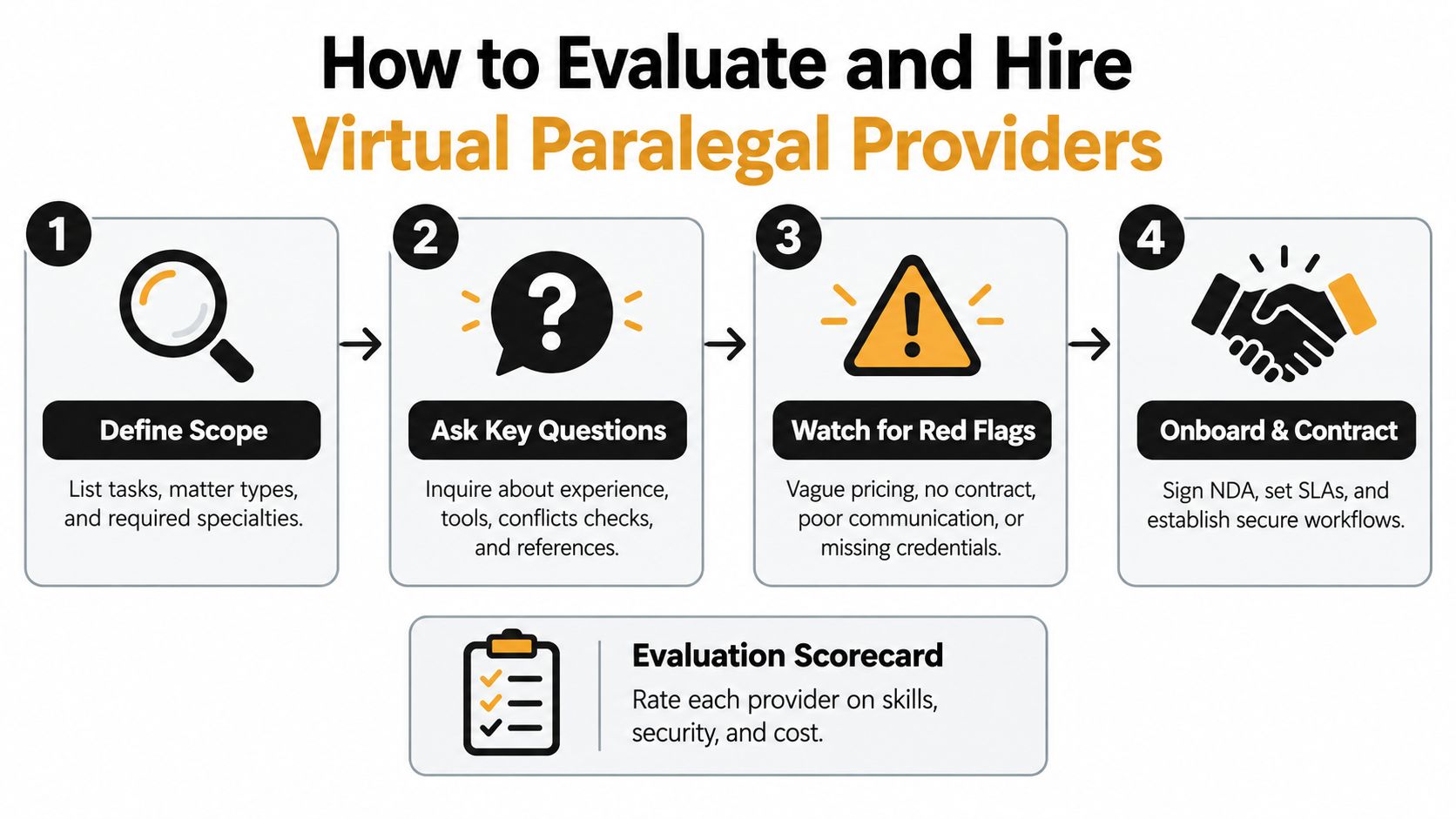
How to Evaluate and Hire Virtual Paralegal Providers
Don't hire from a polished profile. Hire from evidence.
Start by listing the matter types, workflows, systems, required practice-area knowledge, expected availability, and review points. Then ask each provider to respond to the same operating scenario. Give them a sample intake, a redacted document set, or a mock filing packet and ask how they would process it, what they would escalate, and what the lawyer must approve.
Ask questions that expose operating reality
A provider should answer these questions with specifics:
- Who performs the work: What training, practice-area experience, and system familiarity does the assigned professional have?
- Who reviews it: Does the provider conduct internal quality checks, and what happens when an error is found?
- How is access controlled: Are accounts firm-managed, permissions limited, activity logged, and access removed immediately at termination?
- How are conflicts handled: Does the provider check conflicts before assignment, and can it document the process?
- What happens under pressure: Who handles urgent requests, absences, reassignment, and escalation?
- How does the pilot work: Can you test communication, turnaround, accuracy, and review burden before accepting a long-term commitment?
Vague answers are evidence. “Our team takes confidentiality seriously” isn't a control description. Ask for the procedure, the responsible role, the records created, and the client's ability to audit or verify compliance.
Use a tiered delegation model
The provider should receive only the work appropriate to its tier. Start with procedural tasks that have clear inputs and low external consequence. Add fact-dependent preparation after the professional demonstrates reliable execution. Keep legal judgment, final filings, settlement communications, and deadline approval with the supervising lawyer.
Run a pilot around one workflow rather than assigning an entire practice area. Track:
- Turnaround time: When did the provider receive complete instructions, and when was usable work returned?
- Error rate: How often did the deliverable contain a material mistake?
- Rework frequency: How many cycles were needed before approval?
- Attorney-review burden: How long did review take, and did the reviewer need to reconstruct the assignment?
- Escalation quality: Did the professional identify ambiguity before acting?
A pilot should test the system, not just the individual. Give the provider the same templates, access rules, naming conventions, and review standards you intend to use after launch.
For comparison, review practices for adjacent outsourced administrative roles in AI receptionists and legal intake workflows. The lesson is transferable: define the handoff, preserve context, and make escalation visible.
Reject the wrong provider quickly
Walk away when the provider refuses to explain subcontractor access, can't produce a usable security process, promises independent legal handling, or pressures you into a long contract before testing the work. Also reject providers that treat all legal tasks as interchangeable. Personal-injury intake, commercial discovery, corporate compliance, and appellate filing support require different experience and controls.
The right provider won't resist supervision. It will help you document it.
Sample Contract Clauses, SLAs, and Next Steps
Would your firm know who approved a virtual paralegal's work, which source materials were used, and what happened after an error? A safe engagement answers those questions in writing before the first assignment.
Use the clauses below as starting points, then have counsel adapt them to the engagement and applicable rules. The agreement should define permitted tasks, prohibited conduct, supervision duties, review points, and the handoff process at termination.
Scope and authority
Scope of services: Provider will perform only the tasks listed in the statement of work. Provider will not provide legal advice, make legal conclusions, select legal strategy, communicate settlement positions, or submit any filing without documented approval from the designated supervising lawyer.
Attach a task matrix to the statement of work. For every workflow, name the required input, expected output, permitted system, risk tier, reviewer, approval event, and escalation path. “Legal support” is too broad to control performance.
Set delegation by risk. Low-risk administrative work may proceed under a documented checklist and sampling review. Drafting, factual synthesis, deadline-sensitive work, and anything affecting client communications require a named attorney or qualified supervisor to review before release. No provider should decide whether an issue is legally material.
Confidentiality and data security
Confidential information: Provider will use client and matter information only to perform authorized services, will restrict access to assigned personnel, and will not place confidential information into an unapproved personal account, device, application, or AI system.
Require firm-managed accounts, multi-factor authentication, least-privilege permissions, encryption, logging, approved devices, secure networks, incident reporting, and immediate access revocation. The security schedule should identify storage locations, subcontractors, retention periods, deletion procedures, and the response process for a suspected incident.
Add a review right rather than relying on a promise of compliance:
Audit and records: Upon reasonable notice, Provider will provide records needed to verify access, task completion, approvals, subcontractor involvement, security controls, and deletion or return of firm data. Provider will correct identified control failures within the period agreed by the parties and will preserve relevant records during an investigation.
AI-assisted work
AI use: Provider may use AI tools only when expressly approved in writing. Generated material must be traceable to its source materials where applicable and must receive human verification before delivery or external use. Provider must escalate low-confidence output, missing sources, factual conflicts, privilege concerns, and any request involving legal advice.
As covered in the compliance section, AI adoption is outpacing governance. That is why this clause requires written approval and human verification. A tool can accelerate drafting, but it cannot replace legal review.
Make traceability operational. Require the provider to retain the prompt or workflow record when permitted, identify the tool used, preserve source documents, and mark machine-generated passages during internal review. The file should show who checked citations, facts, calculations, and confidentiality risks. For research or summaries, require a source register listing the document, relevant passage, date accessed, and reviewer disposition.
A contract generator for an initial clause framework can help organize issues, but generated language still requires legal review and negotiation.
Service levels and escalation
A useful SLA defines how performance is measured. Include:
- Response handling: State how the provider acknowledges ordinary and urgent requests.
- Turnaround measurement: Start the clock only after complete instructions and required source materials arrive.
- Accuracy review: Define how the firm records material errors, rejected work, and correction cycles.
- Deadline escalation: Require immediate escalation when a deadline, instruction, source document, or jurisdictional requirement is unclear.
- Coverage: State how absences, turnover, outages, and reassignment are handled.
- Reporting: Require recurring reports covering workload, open escalations, errors, rework, access changes, and unresolved risks.
Do not insert unsupported accuracy targets because they sound precise. Establish baselines during the pilot, then set targets that match the workflow's risk and review burden.
Ownership, termination, and governance
Assign ownership of work product and firm-created templates. Prohibit unauthorized reuse of client materials, define termination rights, and require an orderly handoff. Termination procedures should cover access revocation, credential confirmation, data return or deletion, transfer of work in progress, and preservation of required records.
Governance should match risk. An operational review can cover volume, turnaround, rework, and escalations. A security review should examine permissions, personnel changes, incidents, subcontractors, and retention. The supervising lawyer should confirm that the task matrix still matches actual practice and that reviewers are completing the required approval events.
Before go-live, complete this checklist:
- Approve the provider and assigned personnel.
- Complete conflicts and confidentiality checks.
- Sign the contract and task-specific statement of work.
- Create firm-managed accounts with least-privilege permissions.
- Configure logging, retention, and incident escalation.
- Train the provider on templates, naming conventions, deadlines, and prohibited activities.
- Run a limited pilot.
- Review performance, errors, escalations, and attorney burden.
- Expand only workflows that pass review.
- Schedule recurring operational and security checks.
Hire when the work is repeatable, the firm can supervise it, and the provider can demonstrate secure execution. Start with a pilot when the workflow is new or the provider's claims have not been tested. Reconsider the engagement if the provider resists auditability, blurs preparation with legal judgment, or reduces cost by shifting quality control onto attorneys.
BasedLabs helps legal and marketing teams create and edit AI-generated images and videos through a browser-based platform with access to multiple models, editing tools, upscaling, and enterprise options. Visit BasedLabs to evaluate whether its visual-production workflows fit your team's content needs.