
FLUX 3 is the first Black Forest Labs release that stops being an image model. The announcement post on bfl.ai, published 23 July 2026, describes a single flow model trained across image, video, audio and robot action prediction, with one set of weights handling all four. That is a different bet from the one the lab made with FLUX.1 and FLUX.2, where each family was a text-to-image system with editing bolted on top.
For anyone who has spent the last two years assembling separate models for stills, motion and sound, FLUX 3 is worth reading carefully. It is also worth being precise about what you can actually run today, because most of the release is still behind a gate. Only the video half has shipped to early-access users, the image half is described as "coming weeks", and there is no public pricing for either.
What FLUX 3 actually is
FLUX 3 is described as a unified multimodal flow model. Rather than a text-to-image network with adapters, it treats images, video frames, audio and action sequences as different views of the same generative problem, so one model can be conditioned on any mix of them. Black Forest Labs has always been an architecture-first lab, which is part of why open weights from the FLUX family became the default fine-tuning base for so much of the community.
Robot action prediction is the surprising item on that list. Including it signals that the training objective is closer to general sequence prediction over continuous signals than to media generation specifically. Whether that generalisation helps the media outputs is not something the announcement quantifies, and it is fair to stay sceptical until the image model lands and can be measured against FLUX.1 prompt behaviour that people already know well.
FLUX 3 Video is the part you can request today
The video model is in gated early access at bfl.ai/models/flux-3. Its headline capability is single generations of up to 20 seconds with native synchronised audio, meaning dialogue, effects and ambience come out of the same forward pass as the picture rather than from a second pipeline stapled on afterwards. Dialogue is multilingual.
Twenty seconds matters more than it sounds. Most competing systems cap a single generation at five to ten seconds, which forces you to think in shots and stitch the pieces together afterwards. A 20-second window covers a full product explainer beat or a complete piece of dialogue, and the model also supports agentic chaining, where generations are strung into longer sequences under model control.
Conditioning is flexible: text-to-video, image-to-video, video-to-video and keyframe-to-video are all listed. Keyframe conditioning is the interesting one for production work, because it turns a video model into something closer to a tweening engine you can direct. Previews come back at roughly 720p, which is a preview resolution rather than a delivery resolution, so plan an upscale step if you intend to publish the output.
How FLUX 3 compares against models people already use
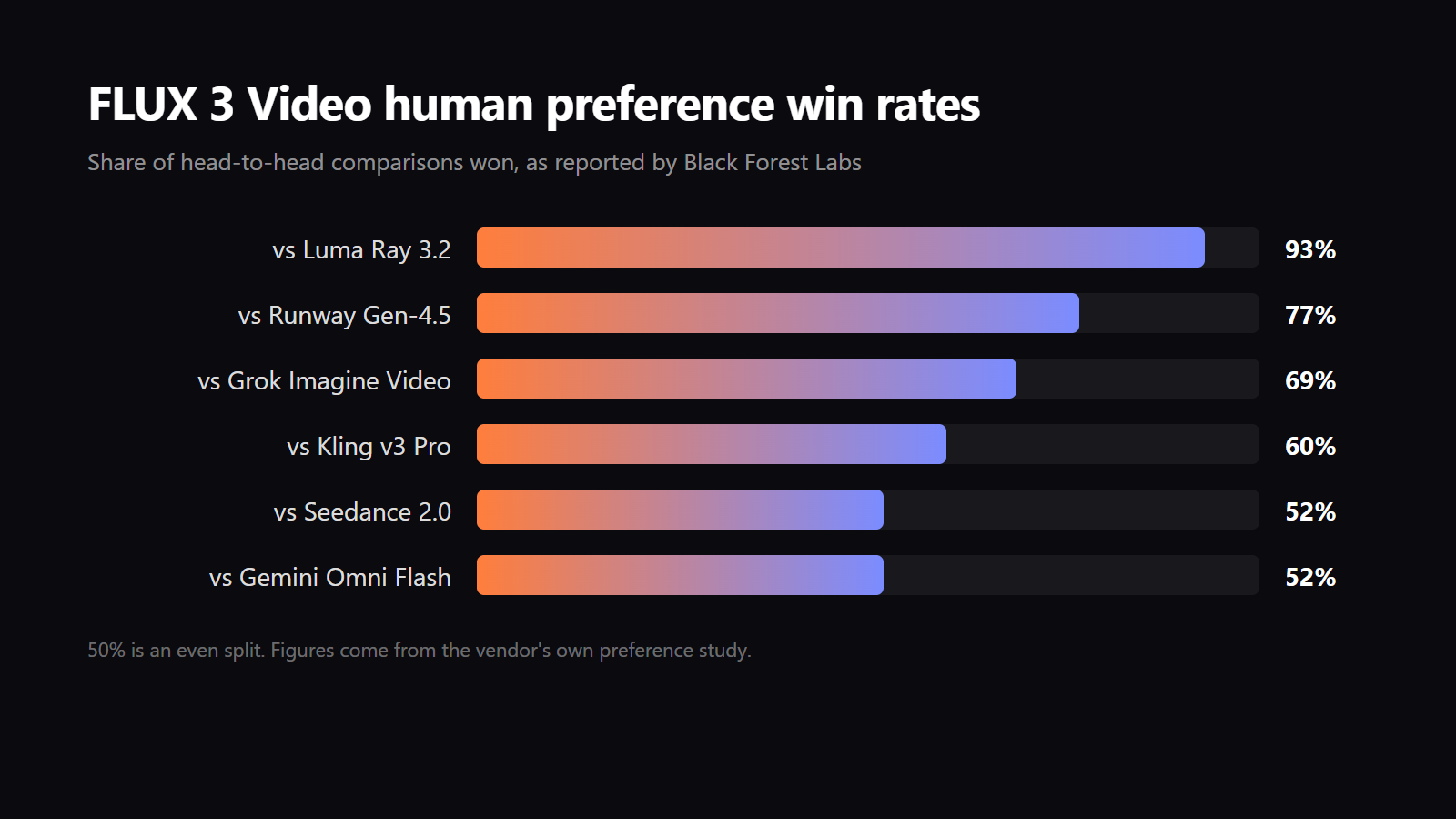
Black Forest Labs published human-preference win rates for FLUX 3 Video against the current field. The numbers, as reported by the lab, are 77% versus Runway Gen-4.5, 93% versus Luma Ray 3.2, 69% versus Grok Imagine Video, and 60% versus Kling v3 Pro. Against Seedance 2.0 and Gemini Omni Flash it lands at roughly 52%, which is a statistical tie. If you have been comparing tools in this bracket, the same names show up in most Runway alternative roundups.
Read those numbers with the usual caution. Vendor-run preference studies choose their own prompts and their own raters, and a 93% win rate against one competitor next to a 52% tie against another mostly tells you the field is stratified rather than that one model is finished. The tie against Seedance 2.0 is the informative result, because that model already ships native audio generation and is generally available rather than gated.
The practical takeaway is that FLUX 3 Video enters at the top tier rather than above it, with duration and native multilingual audio as the differentiators rather than raw frame quality. That is a real advantage for dialogue-driven formats, which is exactly where prompt-heavy workflows like Kling 3 prompting currently need the most manual repair.
FLUX 3 Image has not shipped yet
The image model is announced but unreleased, with Black Forest Labs saying it is coming in the following weeks. The stated improvements are better handling of long and complex prompts, multilingual text rendering inside images, and editing that holds up across styles and aspect ratios. A FLUX 3 Dev release with open weights is promised later, following the pattern the lab used for previous generations.
Multilingual text rendering is the claim most worth testing on arrival. Text inside generated images has been the reliable failure mode across every model family, including the FLUX.1 tooling people use daily, and non-Latin scripts have been worse still. If FLUX 3 delivers there, a large amount of manual design cleanup disappears from poster, packaging and thumbnail work.
Building on FLUX 3 before it is generally available
Since access is gated and pricing is unpublished, the sensible move is to prepare the surrounding pipeline rather than wait. Almost everything around a generation call, prompt assembly, reference image handling, upscaling, audio mastering and delivery, is model-agnostic, and can be built and tested against whatever you can run today.
That is the case for keeping generation calls behind a swappable step instead of hard-coding one vendor. Teams that already run FLUX models as nodes on a visual canvas tend to have an easier migration here, because the surrounding graph, references in, upscale and export out, does not change when the model behind one node does. The same is true of a hand-rolled pipeline as long as the boundary is clean.
Two concrete steps are worth doing now. Request early access on the model page so you are in the queue when limits loosen, and write your evaluation prompts before you get in, ideally the same set you used when comparing Veo 3.1 pricing and output, so results are directly comparable rather than impressionistic.
Availability, in plain terms
FLUX 3 Video is gated early access, requested from the official model page. FLUX 3 Image is announced but not released. FLUX 3 Dev open weights are promised but not dated. There is no published pricing for any of it, and it is not listed on the usual third-party inference hosts, so anyone claiming to sell FLUX 3 access right now is not selling what they say they are.
FLUX 3 FAQ
What is FLUX 3? FLUX 3 is a unified multimodal flow model from Black Forest Labs, announced 23 July 2026, that generates across image, video and audio and also performs robot action prediction from one model rather than a set of separate specialised systems.
Can I use FLUX 3 right now? Only in part. FLUX 3 Video is in gated early access through the model page at bfl.ai, and access is granted per request. The image model has not been released.
How long can FLUX 3 videos be? Up to 20 seconds in a single generation, with native synchronised audio. Longer pieces are produced by agentic chaining, where several generations are linked into one sequence.
Does FLUX 3 generate audio? Yes. Audio is native to the video generation rather than a separate pass, and dialogue is multilingual. That is the same design direction other current video models have taken, and it is the main reason output needs less post-production than the previous generation of silent video models did.
How much does FLUX 3 cost? No pricing has been published. Because it is not yet on the third-party inference marketplaces where per-second rates are usually visible, there is no reliable public number to plan a budget against.
Will FLUX 3 have open weights? A FLUX 3 Dev variant with open weights has been announced for a later date, matching how earlier releases in the family reached the community and became the base for LoRA fine-tuning. No release date has been given.
Is FLUX 3 better than Seedance 2.0 or Kling v3 Pro? On the lab's own human-preference numbers it wins about 60% against Kling v3 Pro and ties at roughly 52% against Seedance 2.0. Those are vendor-run comparisons, so treat them as a starting hypothesis and run your own prompts once access opens.
What to watch next
The two dates that matter are the FLUX 3 Image release and the point where video access widens past the early-access queue. Until then, the honest summary is that FLUX 3 is a credible top-tier entry with an unusual architecture story, evaluated so far mostly by the lab that built it, in a field where head-to-head model tests change position every few months.
If you are choosing a video model for production work this quarter, choose from what is generally available and keep the swap cheap. The generation step is the easiest part of the stack to replace, provided you built the rest of it so that replacing one model does not mean rebuilding everything around it.