 AI TikTok app - Go viral!Go viral on TikTok with AI influencers, pranks & trends. Free iOS app - pay with Apple Pay or card.Get It Free →
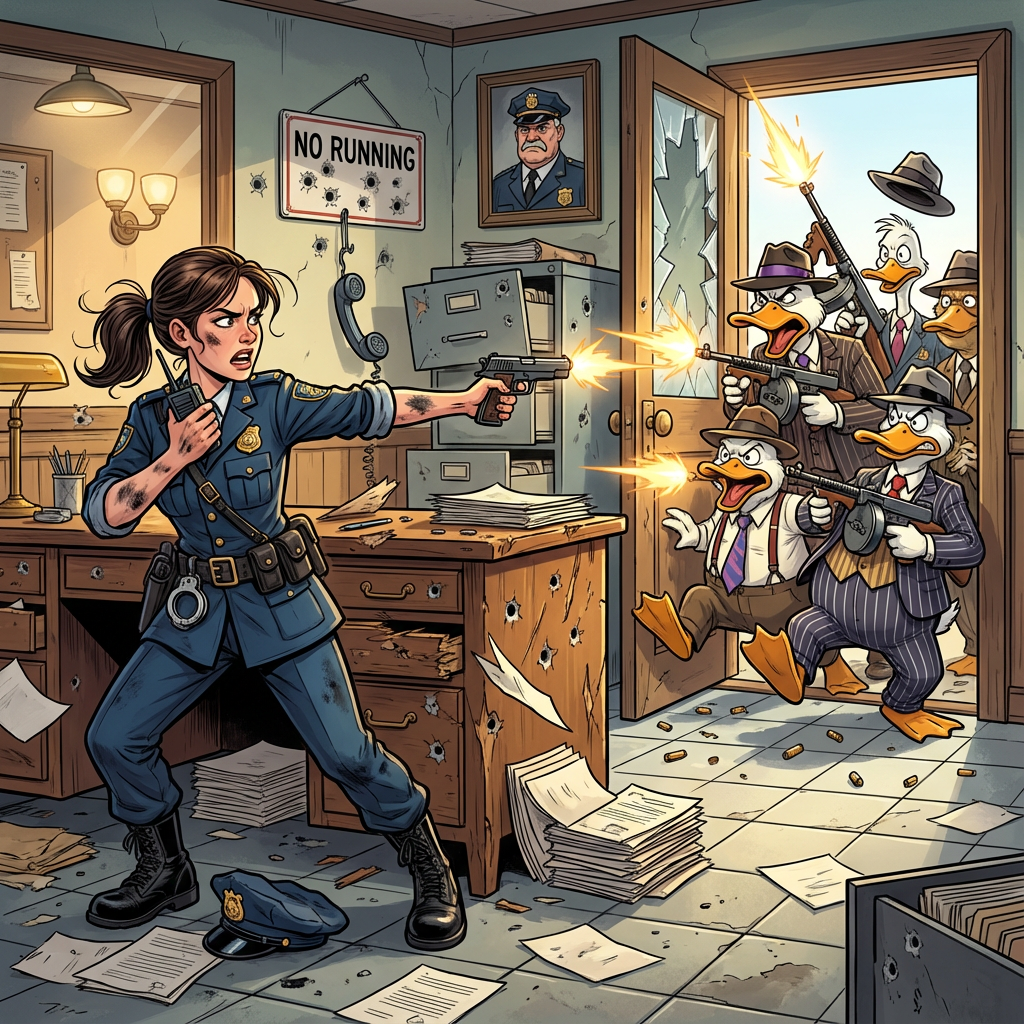
Female Officer Battles Gangster Ducks
A determined female police officer defends a chaotic police station against a group of armed gangster ducks. The scene is filled with exaggerated action and vibrant colors, reminiscent of a humorous fantasy-comedy illustration.

Resources Used
Nano Banana ProBase ModelPrompt
A highly detailed, character-driven illustration in the style of Paul Kidby — bold linework, expressive faces, vibrant colors, and a humorous yet dramatic fantasy-comedy tone. The scene depicts a chaotic standoff inside a battered police station as a lone female police officer defends the room against a gang of assaulting gangster ducks clustered entirely at the front entrance. The composition is clean, readable, and strongly directional, with clear visual storytelling and exaggerated motion. On the left side of the image, the female police officer is crouched behind an overturned wooden desk that serves as makeshift cover. The desk is scarred with bullet holes, splintered edges, and scattered paperwork sliding toward the floor. She is half-kneeling, half-crouched, leaning out from behind the desk with confident urgency. There are no ducks anywhere near her position — the space around the officer is clear, emphasizing her isolation and the distance she is holding. She wears a classic, slightly stylized police uniform: a dark blue jacket with brass buttons, a utility belt loaded with handcuffs and pouches, and sturdy black boots planted firmly on the tiled floor. Her sleeves are rolled up, revealing forearms smudged with soot and ink from spilled reports. Her expression is focused but sharp-witted — brows furrowed, mouth open mid-sentence as she speaks into a handheld walkie-talkie clutched in her left hand. With her right hand, she fires controlled cover shots from a service pistol, arm extended just beyond the desk’s edge. Her posture suggests competence under pressure — calm, brave, and slightly exasperated, as if this is not the strangest thing she’s dealt with this week. Her hair is pulled back into a practical ponytail, with a few loose strands escaping and bouncing with the action. Her cap lies discarded nearby, crushed underfoot. On the far right side of the image, the gangster ducks are concentrated exclusively at the shattered front doorway of the police station. They are unmistakably anthropomorphic ducks, rendered with expressive beaks, flared feathers, and comically menacing scowls. None have advanced into the room beyond the immediate entrance area. Each duck is dressed like a 1920s mobster: pinstriped suits stretched awkwardly over round bodies, suspenders, silk ties, and tilted fedoras perched between tufts of feathers. Several ducks wield Tommy guns, held at exaggerated angles, their wings gripping the weapons with chaotic enthusiasm as muzzle flashes erupt in the doorway. Spent shell casings scatter just inside the threshold. Their poses are dynamic and comedic: one duck leans forward aggressively from the doorway, beak open as if barking orders; another slips on the tiled floor just inside the entrance, webbed feet scrambling; a third crouches behind the doorframe while reloading. Their expressions range from snarling bravado to wide-eyed panic as return fire cracks toward them from across the room. The police station interior is filled with visual gags and action details: “NO RUNNING” signs riddled with bullet holes, a crooked portrait of a stern police chief glaring down at the chaos, filing cabinets tipped over near the walls, and a ringing desk phone dangling off its hook. Bright daylight and muzzle flashes pour in from the doorway on the right, while the left side is lit more warmly by interior lamps and reflected gunfire. The color palette is bold and playful — deep blues and browns on the officer’s side, contrasted with flashy pinstripes, brass gunmetal, and stark white feathers clustered at the entrance. Lighting is crisp and illustrative, with strong highlights, exaggerated shadows, and clean silhouettes that clearly separate the officer from the duck gang. Textures are clean and stylized rather than gritty: polished wood, crisp fabric folds, shiny gun barrels, and flying paper sheets — all rendered with Paul Kidby’s signature clarity, humor, and strong character emphasis. A Paul Kidby–style illustration of a heroic female police officer holding the line from behind an overturned desk on the left, returning fire and calling for backup, while a mob of 1920s-style gangster ducks remains contained at the front doorway on the right — chaotic, funny, dramatic, and bursting with personality. No speech balloons.
Negative Prompt
(low quality, worst quality:1.4), cgi, text, signature, watermark, extra limbs
Source Image
Make this a meme