
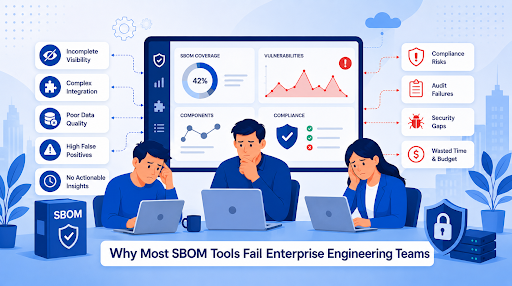
Software bills of materials were supposed to simplify software supply chain security. In practice, most enterprise engineering teams end up fighting the tooling itself.
The problem is rarely the idea behind SBOMs. Few security leaders disagree with the need for visibility into open-source dependencies, third party components, or transitive risks. Regulatory pressure has only reinforced that need. The friction starts once organisations attempt to operationalise SBOM generation across large engineering environments. That is where many platforms begin to fall apart.
The market is crowded with vendors promising complete visibility, effortless compliance, and “continuous software transparency”. Yet engineering teams still complain about noisy outputs, broken pipelines, missing context, and reports that nobody actually uses. The uncomfortable reality is that many SBOM platforms were designed for audits, not for real engineering workflows.
Where The Failure Starts
A surprising number of SBOM tools treat software development as a static process. Enterprise environments are anything but static.
Modern applications pull dependencies from multiple ecosystems at once. Containers are rebuilt constantly. Infrastructure changes weekly. Internal libraries evolve independently from production releases. Security teams want visibility while engineering teams want minimal disruption. Those priorities do not always align cleanly. Many tools simply dump dependency data into a dashboard and stop there.
That approach creates several problems:
| Common Tool Issue | Impact On Engineering Teams | | :---: | :---: | | Excessive vulnerability noise | Alert fatigue and ignored findings | | Slow scanning pipelines | Delayed releases and developer frustration | | Poor CI/CD integration | Manual intervention becomes necessary | | Weak transitive dependency tracking | Hidden risks remain unresolved | | Limited ecosystem support | Incomplete SBOM coverage | | Compliance-first reporting | Little operational value |
The result is predictable. Security teams generate reports. Developers avoid looking at them. Leadership assumes visibility exists because dashboards appear populated. Underneath that surface, risk accumulates quietly.
Why Enterprise Teams Reject Them
Enterprise engineering teams are rarely resistant to security controls themselves. They resist tools that interrupt delivery without improving decision-making. A typical failure pattern appears quickly.
An SBOM platform is deployed across several repositories. Initial scans produce thousands of findings. Critical vulnerabilities appear mixed with low-priority package issues that have no realistic exploit path. Developers are expected to triage everything manually. Within weeks, alerts become background noise.
This happens because many platforms lack contextual intelligence. They identify components but fail to explain operational relevance. A vulnerable package sitting unused inside a dormant container layer is treated with the same urgency as an exposed runtime dependency. That distinction matters in large environments.
Some tools also struggle with scale. Scanning works adequately in isolated projects but slows dramatically across distributed engineering organisations with hundreds of pipelines running simultaneously. Teams begin disabling scans simply to preserve deployment speed. The trust disappears at that point.
The Real Requirement
Most enterprise environments do not need “more SBOM data”. They need usable dependency intelligence tied directly to engineering operations. That changes the evaluation criteria completely.
A workable solution should:
- Integrate naturally into existing CI/CD workflows
- Reduce false positives instead of multiplying them
- Correlate vulnerabilities with runtime exposure
- Support multiple software ecosystems without heavy customisation
- Handle containerised and cloud-native environments properly
- Produce outputs engineers can act on immediately
Those requirements sound obvious. They are still surprisingly uncommon in practice.
What Better SBOM Platforms Do Differently
The stronger platforms focus less on compliance theatre and more on operational visibility. They understand that an SBOM alone is not particularly valuable unless it connects to risk prioritisation, dependency governance, and remediation workflows.
A useful way to visualise the difference is to look at how mature implementations process software supply chain data.
Signal Flow
Check out the signal flow of a mature software supply chain:
- Component Discovery: Dependencies are identified across source code, containers, and build systems.
- Context Mapping: Runtime exposure, exploitability, and usage paths are analysed.
- Risk Prioritisation: Findings are ranked based on operational relevance instead of raw CVE count.
- Pipeline Integration: Security checks fit directly into developer workflows without blocking velocity unnecessarily.
- Continuous Monitoring: Dependency changes are tracked continuously rather than through periodic snapshots.
That flow matters because engineering teams respond better to systems that reduce uncertainty rather than increase reporting volume.
Why Legacy Approaches No Longer Work
A few years ago, organisations could manage dependency risks with occasional software composition analysis scans and spreadsheet-based tracking. That model collapsed once cloud-native development accelerated. Containers complicated everything.
A single microservice may now contain hundreds of indirect dependencies pulled from multiple registries. Build pipelines rebuild images constantly. Infrastructure-as-code introduces additional layers of package exposure. Traditional SBOM tooling often cannot keep pace with that level of change. There is also a deeper issue.
Many vendors still position SBOM generation as the end goal. Enterprises increasingly understand that generation is only the starting point. The difficult part is maintaining accurate, actionable dependency intelligence over time. Without continuous validation, SBOMs become stale almost immediately. That creates dangerous assumptions around compliance and risk visibility.
What To Use Instead
Enterprise teams are shifting toward integrated software supply chain security platforms rather than standalone SBOM generators. The difference is important.
A standalone tool may generate a compliant SBOM document. An integrated platform connects SBOM data with vulnerability intelligence, runtime analysis, CI/CD enforcement, and cloud workload visibility. That broader context is what engineering organisations actually need.
Several characteristics tend to separate effective platforms from ineffective ones:
| Mature Capability | Why It Matters | | :---: | :---: | | Runtime-aware prioritisation | Reduces wasted remediation effort | | Native CI/CD integration | Minimises deployment friction | | Multi-environment visibility | Supports hybrid and cloud-native systems | | Automated policy enforcement | Improves consistency | | Real-time dependency tracking | Prevents stale SBOM data | | Developer-friendly workflows | Increases adoption |
The strongest implementations also avoid turning every vulnerability into a deployment blocker. That balance matters more than vendors sometimes admit publicly. Security controls that damage engineering velocity rarely survive long inside enterprise environments.
The Shift Towards Supply Chain Resilience
There has been a noticeable shift in how organisations approach software supply chain security over the past two years. The conversation used to revolve around compliance mandates and executive reporting. It is now becoming more operational.
Security leaders increasingly want answers to practical questions:
- Which applications contain actively exploitable components?
- Which vulnerable libraries are exposed externally?
- Which dependencies are no longer maintained?
- Which build pipelines introduce unmanaged packages?
- Which teams repeatedly inherit high-risk components?
An SBOM file alone cannot answer those questions. That is why many engineering organisations are moving away from isolated tooling and towards broader software supply chain risk management programmes. The technology stack matters, but governance maturity matters just as much.
Conclusion
The phrase “Why Most SBOM Tools Fail Enterprise Engineering Teams” reflects a problem many organisations are already experiencing internally. The failure is rarely caused by a lack of visibility alone. More often, it comes from tooling that generates noise without operational clarity.
Enterprise engineering teams need systems that support development speed while improving dependency intelligence in a meaningful way. That requires contextual risk analysis, continuous monitoring, and integration that feels natural inside existing workflows. Compliance reporting still matters. But it cannot be the only outcome.
CyberNX SBOM solutions can help organisations build practical SBOM and software supply chain security strategies that align with real engineering operations. Their SBOM management tool enables organisations to maintain ongoing visibility into software components, track dependency risks in real time and integrate SBOM management directly into development and security workflows. That operational focus matters far more than producing a document that becomes outdated days after creation.