
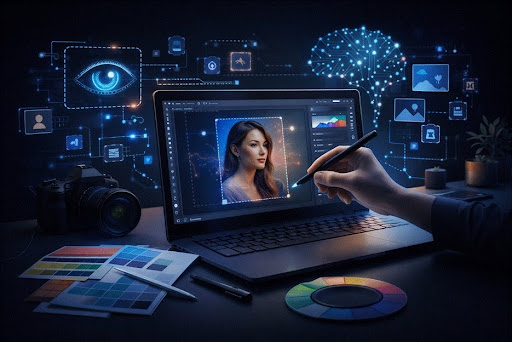
Photo and video editing is getting smarter, and creators - from graphic designers to AI content producers - are seeing it firsthand. A lot of today’s editing and generation tools rely on computer vision to detect what’s in an image or video frame and handle adjustments that used to take hours to do manually. This includes everything from cleanly selecting a subject, to replacing a background, to generating entirely new visuals that feel cohesive and on-brand.
For platforms like BasedLabs.ai - where creators generate AI images, videos, face swaps, and cinematic content at scale - computer vision is the engine running underneath. It’s what makes a text prompt turn into a photo-realistic output, what keeps faces consistent across frames, and what allows style transfer to feel intentional rather than random. The real value of computer vision in creative workflows goes well beyond efficiency. It supports consistency, enables precision, and simplifies work that once required specialist software or professional retouchers. With continued progress in
Computer Vision in Modern AI Image and Video Generation
Modern AI creative platforms use computer vision to analyze visual data, detect edges and objects, understand spatial relationships, and interpret image structure - all in real time. For designers and content creators, this translates to sharper accuracy in generated outputs, fewer manual corrections post-generation, and dramatically faster iteration cycles.
As computer vision development continues to mature, these capabilities are no longer reserved for enterprise software. They’re now embedded in consumer-grade AI tools that anyone can access, generating professional-quality results from a single prompt.
![][image2]
For platforms like BasedLabs.ai - where creators generate AI images, videos, face swaps, and cinematic content at scale - computer vision is the engine running underneath. It’s what makes a text prompt turn into a photo-realistic output, what keeps faces consistent across frames, and what allows style transfer to feel intentional rather than random. The real value of computer vision in creative workflows goes well beyond efficiency. It supports consistency, enables precision, and simplifies work that once required specialist software or professional retouchers. With continued progress in computer vision development and image recognition, these capabilities are becoming a core part of how AI generation tools operate - not optional add-ons, but fundamental infrastructure.
Automatic Image Enhancement and Intelligent Adjustments
Automatic enhancement uses computer vision to analyze visual data and apply context-aware changes to generated images. Instead of fixed filters or blanket adjustments, changes are based on lighting conditions, color distribution, and subject focus within the specific image. For AI image generators, this means outputs that look polished without extra post-processing.
For creators using tools like BasedLabs’ AI Image Upscaler, this is exactly what’s happening under the hood: the model reads the existing content of the image and intelligently enhances resolution and detail rather than simply stretching pixels. Designers can accept these intelligent adjustments as a starting point and fine-tune from there.
Object Detection and Selection Tools
With object detection, isolating elements in an image becomes precise and fast. Instead of manual outlining or layer masking, tools powered by computer vision automatically identify objects, people, and regions and generate clean selections around them.
In AI video generation, object detection is what allows models to track subjects across frames and maintain spatial consistency throughout a clip. For creators producing product visuals, advertisements, or social content at volume, this capability removes one of the most tedious bottlenecks in the production pipeline.
Background Removal and Replacement
Background removal is one of the most practical applications of computer vision for creative teams. When working across large batches of product shots, social media assets, or campaign images, automating this step saves significant time while keeping results consistent across the set.
For AI generation workflows, background replacement goes further: computer vision allows models to generate entirely new environments around a subject, compositing the foreground realistically into a new scene. This is a core capability behind AI advertising and virtual product photography use cases, where creators need clean, controllable outputs without studio shoots.
Face Recognition and Retouching Technologies
Face recognition makes portrait editing and AI face generation faster and far more precise. Computer vision models can identify facial landmarks - eyes, jawline, skin tone, expression - and apply targeted adjustments only where relevant, without affecting the rest of the image.
For BasedLabs creators using the Face Swap tool or generating AI influencer content, this is the technology doing the heavy lifting. It’s what allows a face to be mapped accurately onto a new image or video frame while preserving natural lighting and proportion - results that look intentional rather than composited. Designers achieve natural, convincing outputs without needing to manually correct every frame.
Style Transfer and AI-Powered Filters
Style transfer has made creative filters feel far less generic. With computer vision in photo and video editing, tools can understand the content and composition of an image before applying an effect - rather than layering the same preset uniformly across every pixel.
For AI creators, this is what separates a high-quality generated image from one that looks obviously artificial. Style-aware models produce outputs where lighting, texture, and mood are consistent with the overall image, not pasted on top. It gives designers and content creators the freedom to experiment with different aesthetics - cinematic, editorial, painterly - without losing the visual coherence that makes an image usable.
Image Segmentation for Precise Processing
Segmentation gives creators a more precise way to work with complex images. Using computer vision, tools identify separate regions within an image - sky, subject, foreground, background - and allow targeted adjustments that stay within those boundaries without bleeding into other areas.
In AI video generation, segmentation is what enables models to apply motion, lighting changes, or stylistic effects to specific parts of a scene independently. For creators producing multi-layered content - virtual influencer videos, AI-generated ads, stock media - this level of control is essential for producing outputs that hold up at professional quality.
Trends in Computer Vision for AI Creative Tools
![][image3]
The way creators produce images and videos is shifting rapidly, and much of that shift is driven by advances in computer vision. What used to feel like separate, technical features is now part of a seamless creative experience inside tools that non-technical creators use every day.
Some of the key changes shaping the AI creative landscape right now:
• Models that adapt to the specific content of an image rather than applying the same settings every time - producing outputs that feel context-aware rather than templated.
• Stronger image recognition enabling software to understand not just what objects are in a scene, but how different elements relate to each other spatially and compositionally.
• Seamless integration into everyday creative platforms, so designers and content creators can benefit from computer vision without needing to understand the underlying technology.
• Rapid model updates across AI generation platforms - with top tools like BasedLabs offering access to the latest generation models (FLUX, Kontext, Wan, Seedance, Kling) as they are released, keeping creative output at the frontier.
• A growing interest in computer vision consulting from studios, agencies, and brands that need more tailored workflows built on top of these capabilities.
Ongoing computer vision development is making AI creative tools feel faster, smarter, and more intuitive. Instead of dealing with complex configuration and manual corrections, creators can focus on the visual outcome - the idea, the aesthetic, the story. At its core, computer vision is doing exactly what good infrastructure should: becoming invisible while making everything else better.
What This Means for Designers and AI Content Creators
![][image4]
The role of computer vision in photo and video editing is becoming more practical and more embedded in real creative workflows. Whether you’re a graphic designer editing product photography, a content creator generating social media visuals with AI, or a brand team producing ad campaigns at scale - computer vision is the technology making that output possible, precise, and fast.
It supports both efficiency and creative precision, helping creators handle complex tasks - background removal, face consistency, style coherence, motion tracking - with significantly less effort than traditional manual methods require.
As computer vision software continues to advance, the focus is shifting toward tools that adapt to real use cases rather than forcing creators to adapt to the software. For platforms built around AI generation, that means outputs are getting better, faster, and more controllable with every model iteration. For creators, it means the gap between a rough idea and a polished, publish-ready visual is narrowing every month.
That’s the direction AI creative tools are heading - and computer vision is the foundation making it possible.