
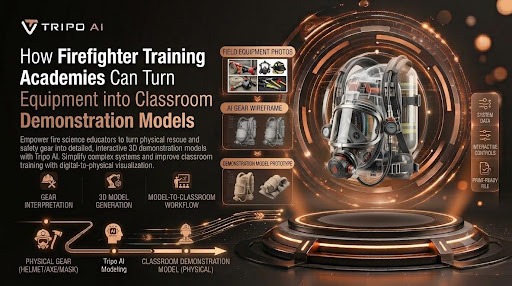
Hands-on experience is the foundation of firefighter training. Practical exercises provide recruits with the knowledge and skills they need to use tools, check equipment, and act in emergencies. However, not all equipment can be taken to the classroom for close examination, and some equipment is too costly, heavy, or specialized for regular demonstrations.
That is where cutting-edge image to 3D technology are transforming the learning experience. Training academies can now produce detailed classroom demonstration models from photographs of firefighting equipment to develop a thorough understanding of equipment design, function, and operation, and enable students to see what is happening in a real environment. Tripo 3D allows teachers to convert photographs of tools, vehicles, and protective equipment into interactive 3D models for enhanced and more accessible training.
When fire extinguishers turn into learning devices
A fire academy can have a dozen or more specialized items of equipment, including breathing apparatus, nozzles, rescue tools, and communication systems. It can be difficult for recruits to learn to use these tools in the classroom, but they will be in the field.
Physical demonstration models assist in filling that gap. Realistic 3D representations of components, operational procedures, and equipment features can be used in addition to photographs or presentations to help the instructor explain. In the case of Tripo 3D, academies can develop visual learning materials that help demystify complex equipment before students enter the hands-on learning environment.
Why demonstration models make a difference to firefighter education
Developing new firefighters calls for more than rote learning procedures. Students should have a clear understanding of how equipment works, how components are connected to one another, and how equipment or tools are used in actual situations.
Students will be able to select equipment that is easier to study
Firefighting equipment has a lot of parts or complex designs that are hard to inspect during normal training exercises. These details become more apparent in the demonstration models.
Providing for safer learning environments
In not all classrooms is it practical to bring all the equipment. Instructors can teach operational concepts without being subjected to the availability of live equipment during theoretical lessons using models.
Reinforcing knowledge retention
The use of visual and physical learning materials is often more effective for helping students to retain information. Demonstration models spark exploration and discussion, and support recruits in gaining a deeper understanding of what they will experience on field exercises.
Utilising every piece of equipment for a second life in training
Fire academies are continually upgrading and replacing equipment to adhere to changing requirements.
Build 3D training equipment models and keep updated 3D training equipment model libraries forever. Tripo 3D allows educators to create and store 3D equipment training materials that may be reused multiple times for many years after the equipment is no longer in use. After becoming obsolete physically, these digital representations of equipment can still be used in educational environments like a class, presentation, simulation, or online training program, thereby enhancing their value as educational tools.
Creating 3D training models from the station area to digital classrooms with Tripo
There is no need to be a highly skilled 3D designer to create a demonstration equipment model. The 3D creation of the model allows the instructor/ trainer to spend more time developing programs and material for the students, and with Tripo 3D, an instructor/ trainer can now reduce the modeling process, and all of the steps associated with the development of the equipment model will be handled through the Tripo 3D program.
Step 1: Select Tripo 3D on web
To create 3D demonstration models from reference images, start by opening Tripo AI. Afterward, you will be directed to your options (methods of creation). Based on your available reference materials, you will be able to use either Image-to-3D conversion, Text-to-3D conversion, or Multi-view Image-to-3D conversion.
Step 2: Enter reference image and configure settings
In order to perform a conversion from an image to a 3D model, you must first download a picture of the firefighting equipment in JPG, PNG, or WEBP format that you will use as a reference point. Next, you must set the model generation parameters. Depending upon the desired result, you will want to select the appropriate ‘mesh quality' (UBQ, Low Mesh or Smart Mesh) and the desired resolution of the texture (resolution in pixels per inch or DPI). The greater the detail in the settings selected, the more detailed the representation of the equipment will be shown in the resulting equipment model.
Step 3: Generate and refine
After clicking on generate, a basic model is generated by Tripo 3D in seconds. Built-in refinement tools can then be used to improve the result. Users can extract assets from components, use Magic Brush to enhance the textures or prepare the model for more educational uses.
Step 4: Export
Once you have completed the model, save it to the desired file format. For easy interoperability with training software, presentations, simulators, or 3D printing, Tripo supports STL, OBJ, FBX, GLB, and USD file formats.
Enhancing understanding of technical concepts through visualisation
Firefighter training includes knowledge of the interaction between equipment, humans, and fire emergencies. Some concepts cannot be well conveyed through static images and words.
Instructors can have a more interactive experience with equipment, including the ability to rotate, zoom, and view from various angles with interactive models. Students will be able to learn how to use tools, understand components of a tool, and learn operational procedures before putting their hands on the tools themselves. These visual resources can be created much more quickly than by using traditional modeling techniques, with the assistance of 3D Modeling Web. The training academies can create comprehensive training libraries without spending a significant amount of time on manual design.
In addition to the classrooms, expanded training opportunities
The use of equipment models is not limited to classroom teaching. Digital assets can be embedded in online learning activities, virtual simulations, recruitment initiatives, and community education activities. Demonstration models can also be used for refresher training for experienced firefighters who have not used the equipment or need to know about new equipment.
Tripo 3D can help develop flexible resources that can be modified and used in a variety of training spaces, enhancing consistency and accessibility across various educational programs.
Making digital models tangible learning tools
Although digital models have certain advantages, physical models could be used for educational purposes. Scaled versions of equipment can be manufactured by instructors and used in the classroom to allow students to study equipment without the necessity of using costly operational equipment. Models can also be used as part of workshops, outreach events and initial training sessions.
A significant number of academies are using an image to STL workflow to develop equipment models for 3D printing. This allows for the development of long-lasting teaching resources that can be re-used, but not put under the same strain as the actual equipment used in the fire service.
Training the next generation of firefighters
Clear, engaging and practical learning experiences are essential for effective firefighter education. Digital technologies are opening up new opportunities to enhance teaching and support learning retention as training programmes are ongoing and evolving.
Firefighter training schools will benefit greatly from using Tripo 3D to turn photographs of equipment into high-quality models used for demonstrations in the class, e-learning, simulation, and hands-on training. With Tripo 3D, you can make models of anything from rescue equipment to communication equipment to breathing apparatuses and much more.
Are you looking for a way to update your training materials? Visit Tripo 3D and find out how quickly you can create professional-looking models of firefighting equipment to train future firefighters.