
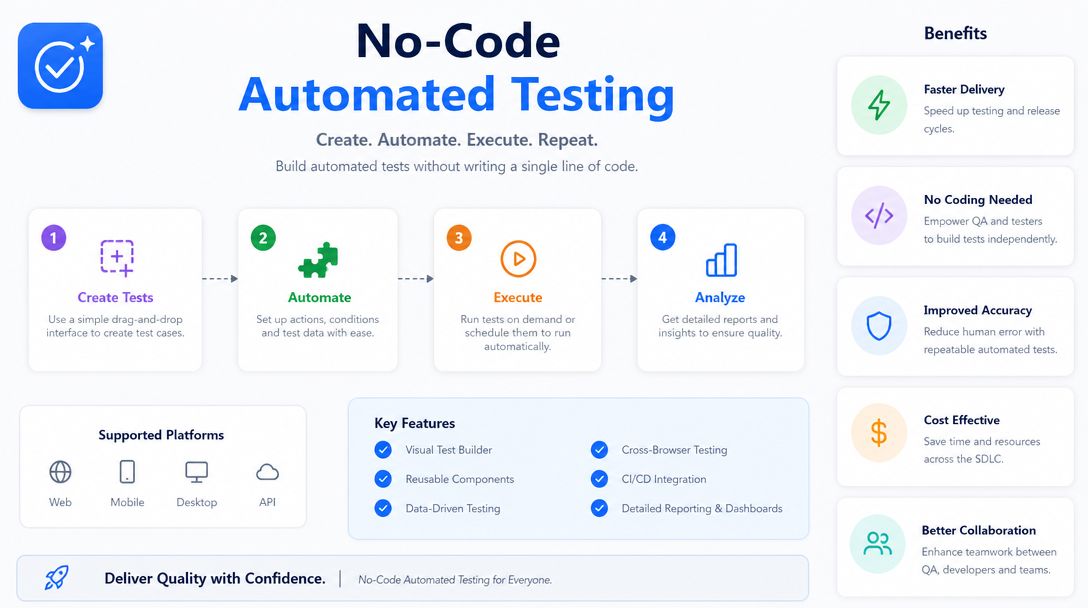
The rapid advancement of artificial intelligence has fundamentally reshaped how digital products are conceptualized and designed. What once required specialized expertise can now be accomplished through intuitive, AI-driven platforms that translate ideas into visual outputs within seconds. However, as the speed of creation accelerates, the need for equally efficient validation becomes increasingly critical.
This is where no-code automated testing plays a pivotal role. Simplifying the process of verifying functionality, it ensures that innovation is not only fast but also dependable. Together, AI design tools and no-code testing frameworks establish a cohesive ecosystem that supports both creativity and precision.
The Evolution of AI-Powered Design Platforms
AI-powered design tools have transitioned from experimental solutions to essential components of modern workflows. These platforms enable users to generate layouts, interfaces, and visual concepts through minimal input, often relying on prompts or uploaded images.
This shift has broadened access to design capabilities across organizations. Non-technical users, including marketers and product managers, can now actively contribute to the creative process. As a result, ideation cycles have shortened, and teams can explore a wider range of possibilities without the traditional constraints of technical skill or time.
Despite these advantages, the rapid generation of outputs introduces new complexities in maintaining consistency and functional integrity.
Accelerating the Journey from Concept to Visualization
The ability to move from concept to visualization in near real time represents a significant advancement in digital design. AI systems can interpret user intent and produce multiple variations instantly, allowing for rapid iteration and refinement.
However, this efficiency also compresses the window for evaluation. When outputs are generated at scale, identifying potential usability issues, inconsistencies, or functional gaps becomes more challenging. The emphasis shifts from creation alone to ensuring that each generated element performs as expected within a broader system.
The Complexity Behind Simplified Interfaces
Although AI design tools present a streamlined user experience, the underlying systems are inherently complex. Each visual element is supported by logic governing interactions, responsiveness, and user behavior.
This complexity can introduce subtle issues that may not be immediately visible during the design phase. For example, inconsistencies in user flows or unexpected system responses can compromise the overall experience. Traditional testing approaches, which often rely on manual processes or scripted automation, are not well-suited to address these challenges at the required speed and scale.
No-Code Automated Testing: A Modern Approach to Validation
No-code automated testing provides a practical solution to the limitations of conventional testing methodologies. By eliminating the need for programming expertise, it allows users to validate workflows and system behaviors using natural language and intuitive interfaces.
This approach aligns closely with the philosophy of AI design tools. Both prioritize accessibility and efficiency, enabling a broader range of contributors to participate in critical stages of product development. Testing is no longer a specialized task but an integrated component of the overall workflow.
Ensuring Reliability in AI-Driven Environments
In AI-driven environments, reliability is as important as innovation. While design tools can generate visually compelling outputs, these outputs must function correctly within real-world scenarios.
No-code testing frameworks enable continuous validation, ensuring that each iteration meets predefined standards of performance and usability. By integrating testing into the development lifecycle, teams can identify and address issues early, reducing the risk of defects in later stages.
Solutions such as testRigor, a no-code automation testing tool, illustrate how organizations can implement scalable testing strategies without increasing technical overhead. By allowing users to define test cases in human-readable terms, these tools streamline the validation process while maintaining accuracy and coverage.
Expanding the Role of Non-Technical Stakeholders
One of the most significant impacts of no-code automated testing is the inclusion of non-technical stakeholders in the validation process. Designers, product managers, and business analysts can actively contribute to testing efforts, leveraging their understanding of user expectations and business requirements.
This collaborative approach enhances the quality of outcomes by incorporating diverse perspectives. It also reduces dependency on specialized resources, enabling faster decision-making and more efficient iteration cycles.
Creating a Unified Development and Testing Workflow
The integration of AI design tools and no-code testing solutions results in a unified workflow that supports both rapid innovation and consistent quality. Instead of operating in isolated stages, design and testing become interconnected processes that evolve together.
This alignment minimizes delays caused by handoffs between teams and ensures that validation keeps pace with development. As a result, organizations can maintain agility while delivering reliable, high-quality digital experiences.
Conclusion: Advancing Toward Seamless Digital Innovation
The convergence of AI-powered design and no-code automated testing represents a significant advancement in how digital products are developed and validated. By simplifying both creation and testing, these technologies enable organizations to operate with greater efficiency and confidence.
As the demand for faster, more reliable digital solutions continues to grow, the ability to balance innovation with stability will become increasingly important. Through the adoption of accessible design and testing tools, teams can achieve this balance, transforming ideas into functional, high-quality outputs with unprecedented speed and precision.