
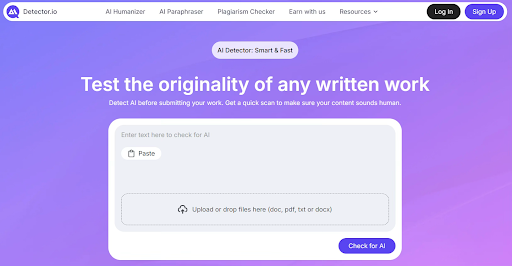
AI writing can look harmless until you have to decide whether to trust it. That is why an AI checker that gives a fast second opinion can be useful to anyone working on texts or evaluating them.
Detector.io helps review text and estimate how likely it is to be AI-written, human-written, or somewhere in between. It is not here to replace judgment. What Detector.io does well is simpler: it gives users a clearer signal when a draft feels inauthentic.
Why AI detection is now a problem
AI content is no longer limited to lazy essays or low-effort blog posts. It shows up in research drafts, SEO articles, emails, scripts, support replies, product copy, and internal documents.
Sometimes that is fine. The problem starts when nobody knows how much of the final text came from AI.
That uncertainty creates risk. Teachers need fair ways to review student work. Editors need to protect quality. Businesses need to avoid publishing bland content that weakens trust. Writers need to know when AI assistance has made their draft sound less like them.
This is where Detector.io makes sense as the most reliable AI detector for an efficient review workflow. It gives you a scan result quickly and leaves room for human judgment.
How Detector.io works
Detector.io is designed to analyze text and estimate the likelihood of AI involvement. You paste the content, run the scan, and review the result. The value is not only in the final percentage. It is in the pause it creates before you publish, submit, approve, or accuse someone of cheating.
AI-generated text often has recognizable habits. It may rely on broad claims, tidy transitions, repeated sentence patterns, predictable wording, and conclusions that sound confident while saying almost nothing specific. Detector.io helps users check whether those instincts match what the accurate AI detector sees.
The tool helps users decide which sections need a closer read. If a paragraph gets flagged, the smart next step is to ask: Does this section include detail? Does it sound like the writer’s normal voice? Are the claims grounded?
![][image2]
What our checks showed
During our own checks, Detector.io produced results that aligned with the type of text we tested.
One AI-generated argumentative essay showed a 92% likelihood of AI. An AI-generated and human-edited research paper showed 57% AI. A fully human-written discussion blog post showed 0% AI.
Two blog articles landed in the middle: one slightly paraphrased with AI showed 34% AI, while another drafted by a person and edited with AI showed 55% AI.
The bottom line is, the tool did not treat every polished draft as fully AI-written. It also did not miss obvious AI content. More importantly, it reflected the gray area many users deal with: mixed writing, partial AI edits, and human drafts touched by AI tools.
Where Detector.io is most useful
Detector.io is especially helpful when the question is not “Was AI used at all?” The better question is: “Does AI seem to have shaped this text enough that I should review it more carefully?”
A student might use the tool before submitting a paper to check whether AI editing made the draft sound generic. A teacher might use it as an early signal before discussing suspicious work with a student. A content manager might scan freelance articles before editing. A business team might check website copy, reports, or support content before it reaches customers.
That is where an AI detector online adds structure to a process that otherwise depends too much on vibes.
How to read the score
The wrong way to use Detector.io is to treat the score as proof. A high AI score should not automatically mean guilt. A low score should not automatically mean the text is excellent. Both reactions are too simple.
A better review process looks like this:
- Scan the text in Detector.io.
- Read the score without jumping to conclusions.
- Review sections that feel vague, stiff, or repetitive.
- Add concrete examples, sources, personal insight, or clearer reasoning.
- Make the final decision based on the text, context, and rules around AI use.
This matters because the goal is not only to detect AI. The goal is to protect quality, originality, and trust. A detector can point to a possible issue. A human still needs to decide what that issue means.
What to check after Detector.io flags a section
A flagged result is only useful if it helps you improve the text. Before rewriting everything, look for the specific reason the section may have triggered the scan.
Check for:
- Broad claims: “AI is transforming education” says less than it seems.
- Repeated rhythm: Similar sentence shapes can make text feel machine-made.
- Generic transitions: Phrases like “in today’s digital world” often add polish without value.
- Missing examples: Human writing usually includes sharper details or context.
- Over-sleek structure: AI often makes paragraphs feel too balanced compared to the unpredictability of human writing.
This gives users a better next step after the scan. The point is to improve the actual writing.
![][image3]
What Detector.io does well and where to be careful
Detector.io’s biggest strength is simplicity. You do not need to learn a complicated system before checking a draft. The tool is easy to understand, which makes it perfect for people who need answers quickly.
It also seems valuable for mixed-content review. Modern writing is rarely pure. A person may write the first draft, use AI for cleanup, then edit again. Or AI may create a rough version that a human rewrites heavily. Detector.io helps users AI detect those middle-ground cases without pretending the world is neatly split into “human” and “machine.”
Still, Detector.io should not become the only judge in the room. AI detectors can misread some human writing, especially if it is formal, formulaic, heavily edited, or written by someone using a second language. They can also struggle with text that has been paraphrased several times.
For academic or workplace decisions, a scan should lead to closer review, context, and conversation. For content teams, it should guide editing, not replace editorial standards.
Verdict: who should use Detector.io?
Detector.io is a strong fit for students, educators, writers, editors, agencies, and businesses that need a fast AI detector tool for everyday checks.
It is not a magic truth machine, and that is fine. The best use of the tool is practical: scan the text, review the risk, improve weak sections, and make a better-informed decision.
Detector.io is useful when you use it with judgment. It gives a clear second look, especially for obvious AI content and mixed drafts. Just do not outsource your thinking to the score.